

August 27, 2026
GDPR-Compliant vs. Data Sovereign: What Really Matters When Choosing Your Tools
6 min.

European server locations are only half the story
Server location Europe is in almost every pitch deck these days. That sounds reassuring, but it only answers one of two questions: A provider can dutifully run its servers in Frankfurt and still be subject to the laws of its home country. Data residency describes the countries and regions where data is stored and processed. Data sovereignty describes which laws govern this data. Both only align if the cloud provider, its parent company, and all involved service providers are subject to European law.
What often happens in practice: An application is advertised as "hosted in Germany," yet it runs on a US hyperscaler, monitoring is handled by an overseas provider, support is accessed from a third country, and the new AI feature calls a model outside the EU. The storage matches. Yet, control does not lie entirely within Europe.
This is not a matter of waving flags, but a question of control: Can you clearly state where your data resides and which jurisdiction it is legally subject to? In discussions with HR and IT, data sovereignty is coming up more and more frequently, triggered by works councils, proof of compliance for customers, or stricter compliance regulations. This article shows why being GDPR-compliant and data-sovereign are not the same thing, what role the CLOUD Act plays, and what you should look out for when selecting cloud solutions. Especially when sensitive personal data from desk sharing is involved.
GDPR-Compliant vs. Data Sovereign: Two Questions, Two Answers
Both terms are often used interchangeably in sales. However, they actually answer very different questions.
GDPR-Compliant | Data Sovereign | |
|---|---|---|
Key Question | Are the data handled in compliance with regulations? | Who can actually gain access in case of doubt? |
Basis | GDPR, BDSG, Data Processing Agreement (DPA) according to Art. 28 | Provider's headquarters and corporate structure, applicable laws, subprocessors |
Typical Proof | DPA, record of processing activities, TOMs, deletion concept, transparency towards data subjects | List of all subprocessors, operating model, key management, support access paths |
Blind Spot | Does not indicate whether foreign authorities can demand disclosure | Does not indicate whether personal data is handled properly in everyday business |
In Brief | Compliance in processing | Sovereignty over access |
This makes GDPR compliance the foundation, not the ultimate goal. Data sovereignty is the concept that covers the other half. If you only check for GDPR compliance, you get clean processes but still carry a residual risk of data access by third parties. If you only look at sovereignty, you might have a European cloud, but no reliable deletion concept. For your company's compliance, you need both!
The CLOUD Act: Why US Law Reaches All the Way to Frankfurt
The 2018 CLOUD Act obligates US companies to disclose stored data to US authorities upon request, regardless of the country in which the servers are located. This affects not only US corporations themselves, but also subsidiaries under their control. As a result, this law collides with Art. 48 GDPR, which generally prohibits the disclosure of data to third-country authorities without a mutual legal assistance treaty. For businesses, this creates risks that can hardly be resolved through contracts.
Three key points that often get overlooked in practice:
The storage location does not protect you. The decisive factor is who has legal control over the data, not the physical data center.
Transparency is limited. Orders can be accompanied by a gag order. Under certain circumstances, those affected may never find out about it.
Providers cannot contract this away. In 2025, Microsoft was unable to guarantee under oath before the French Senate that European customer data would never reach US authorities.
On top of that, there is the situation with the transatlantic data privacy framework. Following the 2020 Schrems II ruling, the EU-US Data Privacy Framework has been in place since 2023. Although the General Court of the European Union upheld the adequacy decision on September 3, 2025 (Case T-553/23), the decision remains vulnerable, and political developments in the US continue to create uncertainty. For your tool selection, this means: relying solely on an adequacy decision to protect your data means building on a foundation that is always subject to change.
Data Residency, Data Sovereignty, and Digital Sovereignty: The Three Levels at a Glance
These terms are often mixed up. Properly separated, they serve as an excellent evaluation framework for cloud computing.
Level | Core Question | How to recognize it |
|---|---|---|
Data Residency (Data Localization) | In which regions are data stored and processed? | Contractually guaranteed locations, including backups, logs, and support systems |
Data Sovereignty | Which laws govern the data and the provider? | Company headquarters in the EU, with no controlling parent company in a third country |
Digital Sovereignty | How dependent is your organization on individual technologies? | Open APIs, clean export formats, open-source components, and no vendor lock-in |
It's only the third level that marks the true difference between "we are allowed to switch" and "we are actually able to switch". A provider that only lets you export data as a PDF is keeping you technically locked in, even if data sovereignty and residency are perfectly aligned. That's why digitalization always requires asking which technologies you could replace in an emergency. Open-source components and well-documented APIs significantly reduce this dependency.
Desk Sharing: Why sensitive data is often left exposed right here
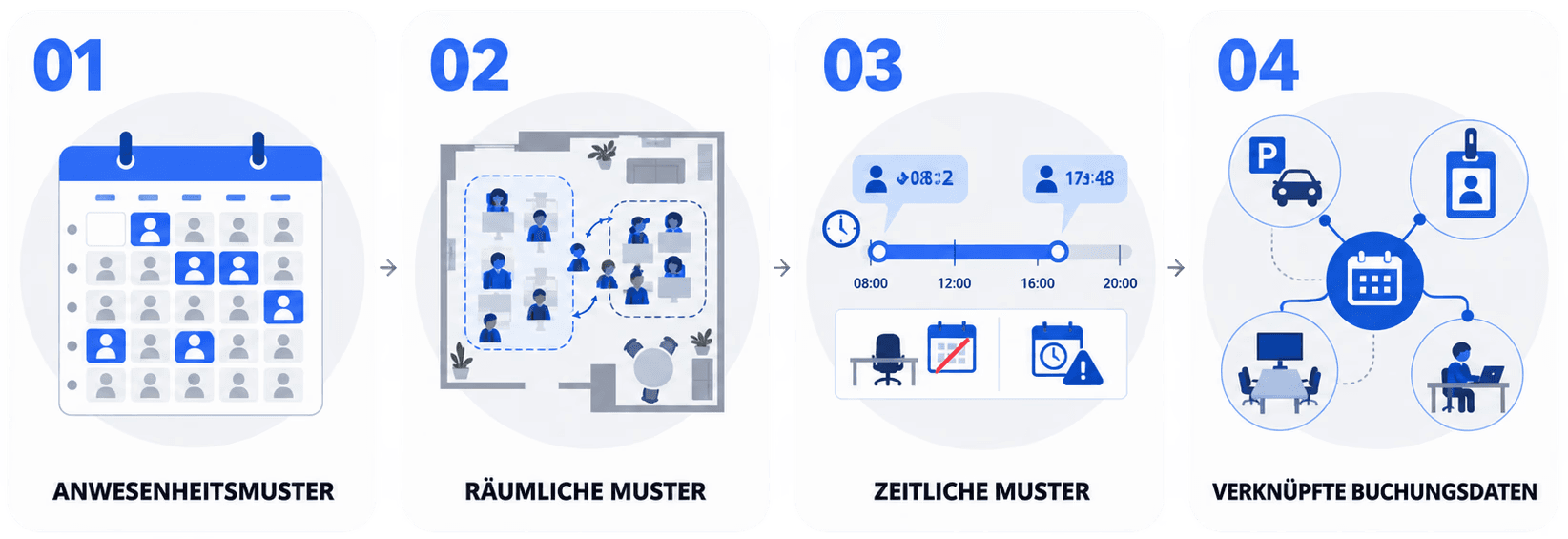
With desk sharing, the data situation might seem harmless at first glance. After all, it's "just" about desks. In reality, however, daily use creates one of the most revealing data collections in the company:
Attendance over weeks and months: who was in the office when, and who predominantly works remotely
Spatial patterns: who regularly sits next to whom, and which teams mix
Temporal patterns: check-in and check-out times, no-shows, and short-term cancellations
Linkable information: bookings of parking spaces, visitors, or meeting rooms
In short, this data can easily be used to draw conclusions about behavior and performance. This is exactly why desk sharing is subject to co-determination: software suitable for monitoring behavior or performance falls under § 87 Paragraph 1 No. 6 of the German Works Constitution Act (BetrVG). The works council rightly takes a close look here, and nowadays they ask about much more than just the server location—they look at the entire setup.
What helps in practice: data minimization (only collecting what is absolutely necessary for the booking), short and configurable deletion periods, evaluations that are solely aggregated and anonymized, clear role and permission concepts for access, and a works agreement that specifies exactly that. Data protection and data security go hand in hand here!
Subprocessors: Where Cloud Solutions Quietly Lose Their Sovereignty
Sovereignty rarely fails at the main provider. It fails at the chain behind them. Every service that a software uses in the background is a sub-processor and belongs in the data processing agreement. Typical candidates:
Hosting and Backup: often a hyperscaler, sometimes with replication to other regions
Monitoring, Logging, and Error Analysis: frequently US services that record metadata and traffic
Email and Notification Delivery: booking confirmations containing names and times
Support and Ticket Systems: this is where screenshots with real personal data often end up
Analytics and Session Recording: an underestimated channel for sensitive information
AI Features: the key question is where the model is operated and whether inputs are used for training
A single provider from a third country is all it takes to break the chain. That is why the current list of sub-processors is the most honest document you can get from a cloud provider. It shows you in just five minutes whether data sovereignty is just a promise or a true operating model.
Sovereign Cloud: What It Needs to Deliver (And What It Doesn't)
The term sovereign cloud is often vague and claimed by many different models. It becomes practical when you measure it against clear criteria. At a minimum, a sovereign cloud should:
Store and process data exclusively in European data centers, including backups, logs, and testing systems
Only use subprocessors subject to European laws, fully documented and with advance notice of any changes
Provide operations and support from within the EU, with zero administrative access from third countries
Make key management transparent, ideally separating operation from key ownership
Ensure portability, meaning complete exports in open formats and fully documented APIs
What a sovereign cloud is not: a replacement for robust IT security. Certifications such as ISO 27001 or BSI C5, penetration testing, and an active information security management system remain essential. Data security and data sovereignty solve different challenges. While initiatives like Gaia-X and the EU Cloud Code of Conduct provide excellent guidance, they do not replace your own due diligence. And sovereignty is not an all-or-nothing deal: for many industries, a European provider with a clean chain of custody is perfect, while public authorities, healthcare, and other regulated sectors require stricter models.
10 Questions Companies Can Use to Take Control of Their Data
You can copy these questions directly into a vendor meeting or a request for proposal (RFP):
Where exactly is data stored and processed, including backups and logs?
Where is the company headquartered, and is there a parent company outside the EU?
Which sub-processors are used, and in which countries are they located?
How are changes to the sub-processor list announced, and what objection rights do we have?
From which regions are administrative access and customer support access carried out?
Who manages the keys, and how is encryption handled both in transit and at rest?
Which certifications are held, and when was the last external audit conducted?
What data is generated during desk sharing, what retention periods apply, and are they configurable?
What do reports look like, are they anonymized, and are insights traced back to individuals prevented?
How do we transition out? Think export formats, transition periods, and data deletion after contract termination.
If a provider struggles to answer questions 3 or 5, that tells you much more about the actual risks than any certificate on their website!
Data Sovereignty with anny: Opt for a Dedicated EU Cloud
With anny, standard operations are based in Germany, the infrastructure is ISO 27001-certified, and a comprehensive Data Processing Agreement (DPA) covers all GDPR requirements. On top of that, we embrace principles that are especially crucial for desk sharing: we only collect the data necessary for the booking, analytics run anonymously, and deletion periods can be customized to your needs.
Since data sovereignty is becoming a strict selection criterion for more and more companies, we also offer the anny EU Cloud: a dedicated environment utilizing exclusively European subprocessors. The difference isn't just a flag on the website, but the entire chain behind it. Demand is visibly growing, especially where works councils, corporate IT, and clients all require proof at the same time.
In the end, it’s not about ideology, it's about proof. When you can give a clear answer to the question "Where is our data stored and who legally governs it?", the discussion instantly loses its edge. And that is exactly where the practical value of data sovereignty lies.
FAQ: Your Guide to GDPR Compliance and Data Sovereignty with anny
What does data sovereignty mean?
Data sovereignty means that an organization retains control over where its data is stored, who can access it, and which laws apply to it. The focus is on access, not just on data storage.
Is software automatically GDPR-compliant if the servers are located in Germany?
No. The server location is just one piece of the puzzle. GDPR compliance also depends on data processing agreements, technical and organizational measures, deletion concepts, and whether data is transferred to third countries.
Does the CLOUD Act also apply to European subsidiaries of US providers?
According to the prevailing view, yes, provided the US parent company has power of disposal over the data. Having a European headquarters for the subsidiary alone does not reliably rule out access.
What is the difference between data privacy and data security?
Data privacy regulates whether and how personal data may be processed. Data security encompasses the measures and technologies that protect data from loss, manipulation, and unauthorized access. Data sovereignty complements both by addressing the question of legal jurisdiction.
What role do Gaia-X and the EU Cloud Code of Conduct play?
Both projects establish common criteria and greater transparency for European cloud services. They serve as a great guide during pre-selection, but do not replace your own audit of subprocessors and contracts.
What does the works council look out for in desk sharing tools?
Above all, they check whether behavior or performance can be deduced from the booking data. Typical topics include the scope of the information collected, retention periods, access rights, evaluation logic, and the question of who outside the company could have technical access.




" height="38px" id="bH388uk2E" transform="translate(1 1)" width="118.00000395534607px"/></svg>)