

Amira van Weegen
Marketing Manager
January 13, 2026
Hybrid Work in the DACH Region: Legally Compliant Implementation 2026
5 min.

Employment Law, Data Protection & More: Legally Compliant Implementation of Hybrid Work
Hybrid work in the DACH region has long become the new reality – but implementing it legally is complex. Employers in Germany, Austria, and Switzerland must adhere to different laws regarding working hours, occupational safety, data protection, and co-determination. Especially for HR managers, the question arises: How can hybrid work be legally compliant without losing flexibility and efficiency?
In this guide, you will receive a comprehensive overview of the legal framework for hybrid work in 2026, practical tips for implementation, and a direct comparison of the DACH countries. This ensures that your company is both compliant and future-proof.
Here's what you'll gain
This guide provides you with a comprehensive overview of the legal framework in Germany, Austria, and Switzerland. Additionally, you'll find practical checklists and tips for creating safe and ergonomic home office workspaces. Furthermore, you will receive important insights on cross-border specifics and compliance requirements that companies in the DACH region need to consider.
DACH Comparison: Overview of Key Legal Areas
The legal framework for hybrid work varies significantly between Germany, Austria, and Switzerland. The following overview highlights the key differences and similarities in areas such as working hours, employee participation, data protection, as well as occupational safety and ergonomics.
Legal Area | Germany | Austria | Switzerland |
|---|---|---|---|
Working Hours & Recording | Working Hours Act (ArbZG) with maximum working hours, breaks, and rest periods. BAG ruling 2022: Obligation for systematic working time recording (legal implementation pending). | Working Hours Act (AZG) with flexible flexitime regulations (up to 12 hours/day, compensation over 13 weeks). Complete time recording required. | Labor Act (ArG): Weekly working hours 45 hours (office) or 50 hours (industry). Rest periods at least 11 hours. Recording obligation, exceptions for senior executives. |
Employee Participation | Works Constitution Act § 87: strong co-determination rights of the works council | Works Council Act: similar co-determination rights as Germany | Weaker staff representation rights, often no mandatory co-determination right |
Data Protection | Complete implementation of GDPR. Strict requirements for data processing, transparency, and IT security. | GDPR implementation, supplemented by the 2021 Home Office package (including adjustments in AVRAG, ASchG, EStG). | New Data Protection Act (DSG) since September 2023, heavily based on GDPR, but more pragmatic with national specifics. |
Occupational Safety & Ergonomics | Workplaces Ordinance and Occupational Safety Act. Obligation for risk assessment also for home office workplaces. | Employee Protection Act (ASchG), supplemented by the 2021 Home Office package: ergonomic requirements and employer duties. | Obligations Law (OR), Art. 328 Duty of Care: health protection and appropriate workplace equipment. Implementation pragmatic, more employee responsibility. |
Work Hours and Time Tracking in Hybrid Work: Obligations in DACH
Germany
Since the BAG ruling on September 13, 2022, there is a mandatory requirement for systematic time tracking in Germany. This also applies to home office, telework, and mobile work. It is governed by the Working Hours Act (ArbZG), which sets maximum working hours, breaks, and rest periods. The specific legal arrangements are still in progress – therefore, companies should proactively adopt digital time tracking systems that ensure data protection and compliance. (Source: BMAS, BKA)
Austria
The Austrian Working Hours Act allows flexible flexitime models of up to 12 hours a day, provided the average over 13 weeks is 8 hours. Here, too, time tracking is mandatory. Additionally, the 2021 Home Office Package (amendments including AVRAG, ASchG, EStG) regulates ergonomic requirements and tax allowances for remote work. (Source: BMASK)
Switzerland
The Swiss Labor Law (ArG) stipulates a weekly working time of 45 hours (office work) or 50 hours (other activities). The recording of working time is generally mandatory, with exceptions for executives and employees with independent time management. Rest periods and daily limits are flexible, as long as legal requirements are met. (Source: SECO)
Influence in Hybrid Work Models: Rights and Responsibilities in DACH
Germany
The Works Constitution Act (§ 87 BetrVG) grants works councils comprehensive co-determination rights when introducing hybrid work models. Working hours, location, technical equipment, and data protection must be regulated in a collective agreement. Without the consent of the works council, binding regulations are not legally permissible.
Austria
In Austria, works councils also have strong rights. The Works Councils Act requires companies to establish collective agreements for hybrid work. These agreements regulate key issues such as cost coverage, work time arrangements, and health protection. Only through early involvement of the works council can legally sound agreements and high acceptance be achieved.
Switzerland
In Switzerland, the co-determination rights of staff representations are less pronounced. Employers can often introduce hybrid work models independently. Nevertheless, it is advisable to actively seek dialogue with the workforce to promote transparency, motivation, and acceptance.
Data Protection in Hybrid Work: An Overview of GDPR and DSG
Germany & Austria
As EU member states, Germany and Austria fully implement the General Data Protection Regulation (GDPR). There are strict guidelines for hybrid work:
Separation of personal and professional data must be ensured at all times.
VPN connections and encrypted data transmission are mandatory to protect sensitive information.
Regular software updates and security patches prevent vulnerabilities.
Reporting obligations for data breaches must be strictly adhered to – companies must report incidents to supervisory authorities within 72 hours.
Switzerland
The revised Data Protection Act (DPA) has been in force since September 2023 and is strongly aligned with the GDPR but includes national specifics:
Extended information obligations: Employees and customers must be comprehensively informed.
Reporting obligation for data breaches also exists, though the requirements differ in detail.
For international data transfers, the EU adequacy decision, Standard Contractual Clauses (SCC), and Transfer Impact Assessments (TIA) are mandatory protective measures.
Occupational Safety & Ergonomics in Hybrid Work Environments
Here's the deal
Employers are required to ensure safe and ergonomic workspaces, even when working from home. The legal foundations for this are:
the Workplace Ordinance and the Occupational Safety and Health Act in Germany,
the Employee Protection Act (ASchG) in Austria,
as well as the Duty of Care under the Code of Obligations (CO) in Switzerland.
Minimum standards include: ergonomic furniture (desk, chair), good lighting, a healthy indoor climate, and protection from psychological stress.
How to Implement
To ensure that hybrid work is both legally compliant and promotes health, companies should establish the following measures:
Conduct and document risk assessments systematically
Provide ergonomic equipment: height-adjustable desk, ergonomic chair, external monitor, keyboard & mouse
Offer training for employees on ergonomics, break management, and health protection
Ensure IT security measures like VPNs, firewalls, and regular updates
Establish clear rules on working hours, breaks, and availability to prevent overload
Pitfalls
Despite clear guidelines, many mistakes still occur. Common risks include:
Inadequate equipment → Health issues, increased downtime, and liability risks
Unclear cost allocation → Conflicts arise when it is unclear who bears the cost of furniture or electricity
Data protection risks → Insecure private networks or devices without protective measures
Mental stress → Isolation, lack of social contact, or blurred boundaries between work & personal life
Companies that invest early in ergonomic standards and clear guidelines not only reduce health risks, but also increase acceptance and productivity in hybrid work settings.
Edge Cases: Legal Considerations in Cross-border Hybrid Work
Hybrid work presents particular challenges when employees regularly work in another country or commute. Companies in the DACH region must consider additional legal aspects to avoid compliance risks.
Important Checkpoints Before Starting
183-Day Rule (Taxes): If the limit of 183 working days in the home country is exceeded, tax residency might change - double taxation is possible.
Social Security: Responsibilities must be clearly defined through an A1 Certificate to avoid contribution conflicts.
Double Taxation Agreements: Germany, Austria, and Switzerland have bilateral agreements that must be strictly adhered to in hybrid models.
Data Protection: For cross-border work in Switzerland, the EU Adequacy Decision as well as Standard Contractual Clauses (SCC) and Transfer Impact Assessments (TIA) apply for international data transfers.
Labor Law: Responsibilities can shift with regular home office abroad – individual legal advice is strongly recommended here.
Companies should examine and document these points early on to avoid legal pitfalls in cross-border work.
Checklist: Legally Compliant Setup of Hybrid Work in Enterprises
To ensure hybrid work in the DACH region is not only efficient but also legally compliant, companies should consider these key points:
Document working hours regulations in writing - including time tracking, breaks, and home office days.
Ensure employee participation - involve the works council or staff representation from the beginning.
Guarantee ergonomics and safety - conduct risk assessments and equip workplaces ergonomically.
Implement data protection & IT security - establish clear concepts with VPN, regular updates, and BYOD guidelines.
Make contractual agreements - regarding home office rules, cost coverage, and liability issues.
Train employees regularly - on topics such as occupational safety, data protection, and working hours regulations.
Examine cross-border specialities - consider tax, social security, and data protection in an international context.
Establish feedback and monitoring systems - for continuous improvement, compliance, and acceptance.
With this checklist, companies ensure that hybrid work models in the DACH region are implemented in a legally compliant and sustainably successful manner.
How anny helps companies implement hybrid work in a legally compliant manner
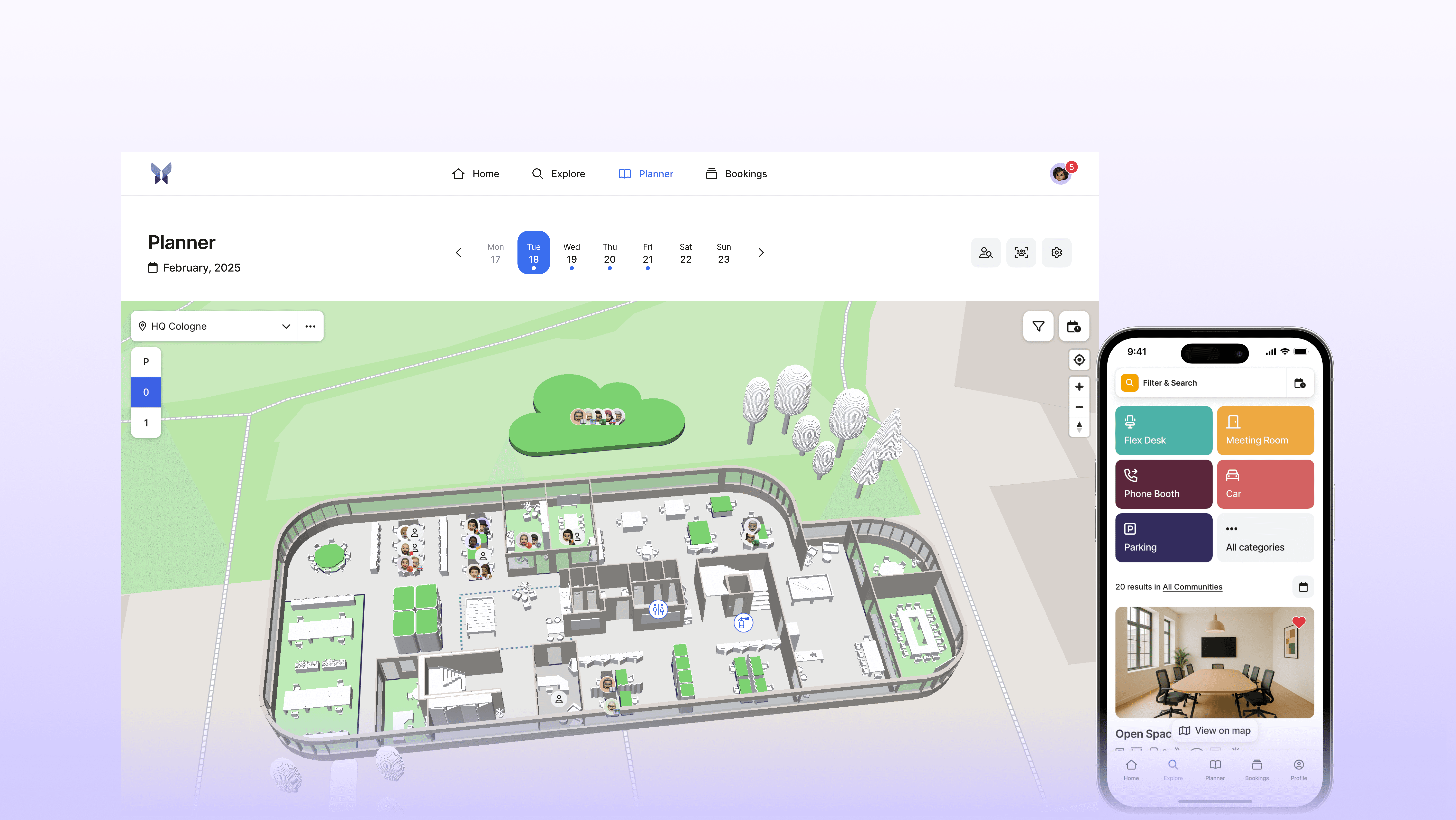
Compliance with legal frameworks in hybrid working is complex, ranging from data protection (GDPR/BDSG) to working time recording and company agreements. This is where anny supports as a central platform for desk and room booking.
With anny, companies benefit from practical solutions that combine legal certainty and efficiency:
GDPR-compliant & secure: Thoughtful deletion concepts and role/rights management protect sensitive data.
Seamless integration: Connection to MS 365, Google Workspace, and other tools for smooth workflows.
Transparency through analytics: Reports and evaluations help maintain company agreements and prove compliance at any time.
Efficiently manage hybrid working: Desk and room booking, meeting room management, and flexible workplace concepts on a single platform.
Schedule a free demo now to make your hybrid work model legally secure and future-proof.
Disclaimer: This guide does not replace legal advice. For binding information, please consult qualified legal advisors or official sources such as BMAS, BKA, SECO, and the EU Commission.





" height="38px" id="bH388uk2E" transform="translate(1 1)" width="118.00000395534607px"/></svg>)