
April 23, 2026
IoT Automation in Office Buildings: How Facility Managers Can Reduce Costs and Effort Long-Term
6 min.

The hidden cost problem in office buildings
Tuesday morning, 8:30 a.m., in a German office building. Only 50% of employees are on site, the rest are working from home. Yet all five floors are running at full capacity: lights on, HVAC set to comfort temperature, the underground garage half empty but fully lit.
Hybrid work models have dramatically changed real space utilization since 2020. Bitkom surveys from 2022/2023 show that around 60% of German companies have permanently established hybrid models. The result: operations are still aligned to the building, not to actual usage.
The core challenge is less a budget issue than an information issue: If you don't know which spaces are truly being used and when, you can't control them effectively. This is exactly where IoT automations come in - booking-based, automatic, and data-driven.
How much money is unnecessarily lost in office buildings
The numbers speak for themselves. According to the latest study “Adaptive Spaces – 2026 CBRE Global Workplace & Occupancy Insights” average office occupancy worldwide is just 53%—and that is already the highest level since March 2020. In 2024, that figure was still 38%. This means: Even in the best case, just under half of all office space remains empty on an average workday. The ifo Business Survey further sharpens this picture for Germany: In typical office sectors such as IT, management consulting and advertising, up to 40% of on-site workstations are unoccupied today because of remote work—three times more than before the pandemic.
The core problem: building systems are still running at full capacity. Heating, ventilation, air conditioning and lighting are based on operating hours, not actual occupancy. In standard offices, energy costs account for a significant share of total operating expenses—and are therefore one of the biggest levers for savings.
The savings potential of demand-driven IoT automation is correspondingly substantial. Fraunhofer ISE measures up to 20-25% reduction through IoT-controlled heating, ventilation and air conditioning systems. In fully integrated smart office setups, Shelly has even documented savings of 30-50% in its own practical evaluations—depending on building type and initial situation.
A concrete calculation example illustrates the scale:
An office building with 10,000 m² and energy consumption at the market average generates annual energy costs of around €110,000. Even with a conservative 20% savings through intelligent automation, that means more than €20,000 less per year—money that is currently going to waste right now.
What does office building automation mean exactly?
Office building automation means building systems no longer react to fixed schedules, but to actual usage. Sensors, IoT devices and central software communicate with one another and control the building according to demand. Typical systems that are automated in this way:
Lighting – switching on and off based on occupancy or time of day
Heating, ventilation & air conditioning – comfort mode only where people are
Blinds & solar shading – automatically adjusted to light conditions
Sockets & devices – selectively control presentation equipment, coffee machines, displays
Access control – digital permissions instead of physical keys
Each of these control levers can be automated individually. But the real leap in efficiency only comes when all systems run on a shared data foundation.
That is exactly the decisive lever: the linking of booking data and IoT. Automation that relies only on schedules works with assumptions – the light turns on at 8 a.m. because someone could theoretically be there. Booking-driven automation works with facts: The meeting room is booked from 10-12, so the lights, climate and access switch on exactly for that period and then automatically switch off again. No room booked means no unnecessary operation.
Booking-driven IoT automation with anny
anny is a central booking platform for rooms, desks, parking spaces, and equipment. The key principle behind it: thanks to bookings, anny knows exactly when which space is being used and automatically controls connected IoT devices on that basis. No room booked means no unnecessary operation.
For facility managers, that means fewer manual interventions, clear rules, and a consistent control logic across all locations.
Control lighting & energy intelligently – the Shelly integration
Shelly is one of the most established providers of IoT relays and switches. The devices can be retrofitted into existing electrical installations – without structural work – and control lights, sockets, blinds, and other electrical loads directly over the network.
Setup in anny follows three steps:
Connect the Shelly device – directly in anny settings
Define the booking rule – e.g. „Lights on when booking starts, off when booking ends"
Done – automation runs, no further intervention needed
In practice, it looks like this: Meeting room „Berlin" is booked via anny from 10:00 to 12:00. At 9:59 a.m., the lights switch on automatically, optionally also the display and projector. At 12:00 p.m., everything turns off again without anyone having to touch a switch. The same applies to power strips, coffee machines, or presentation equipment in meeting areas.
→ Learn more about the Shelly integration in anny
Automate access control – smart locks
Physical key management, manual activations, and lost keys are classic long-term issues in facility management. Smart locks solve this structurally, not with more effort, but with less.
anny integrates with a wide range of leading providers: NUKI, Salto KS, Tapkey, dormakaba, KleverKey, iLOQ and Comydo. The principle works the same in every case: employee Lena books the project room via anny from 2:00–4:00 p.m. She automatically receives access permission on her smartphone. At exactly 2:00 p.m., the door opens via NFC or app. At 4:00 p.m., the permission is automatically revoked – without anyone in facility management having to intervene manually.
The benefits at a glance:
Without anny | With anny | |
|---|---|---|
Lighting & Energy | Manual or scheduled | Booking-based, automatic |
Access Control | Key handover, manual activation | App/NFC, automatic rights assignment |
Traceability | No or incomplete documentation | Complete digital history |
Space allocation decisions | Gut feeling | Heatmap data |
Make data-driven space decisions
IoT automation solves today’s problem: energy is only consumed where people are actually present. The analytics in anny solve tomorrow’s problem: Which spaces do we still need at all, and in what form?
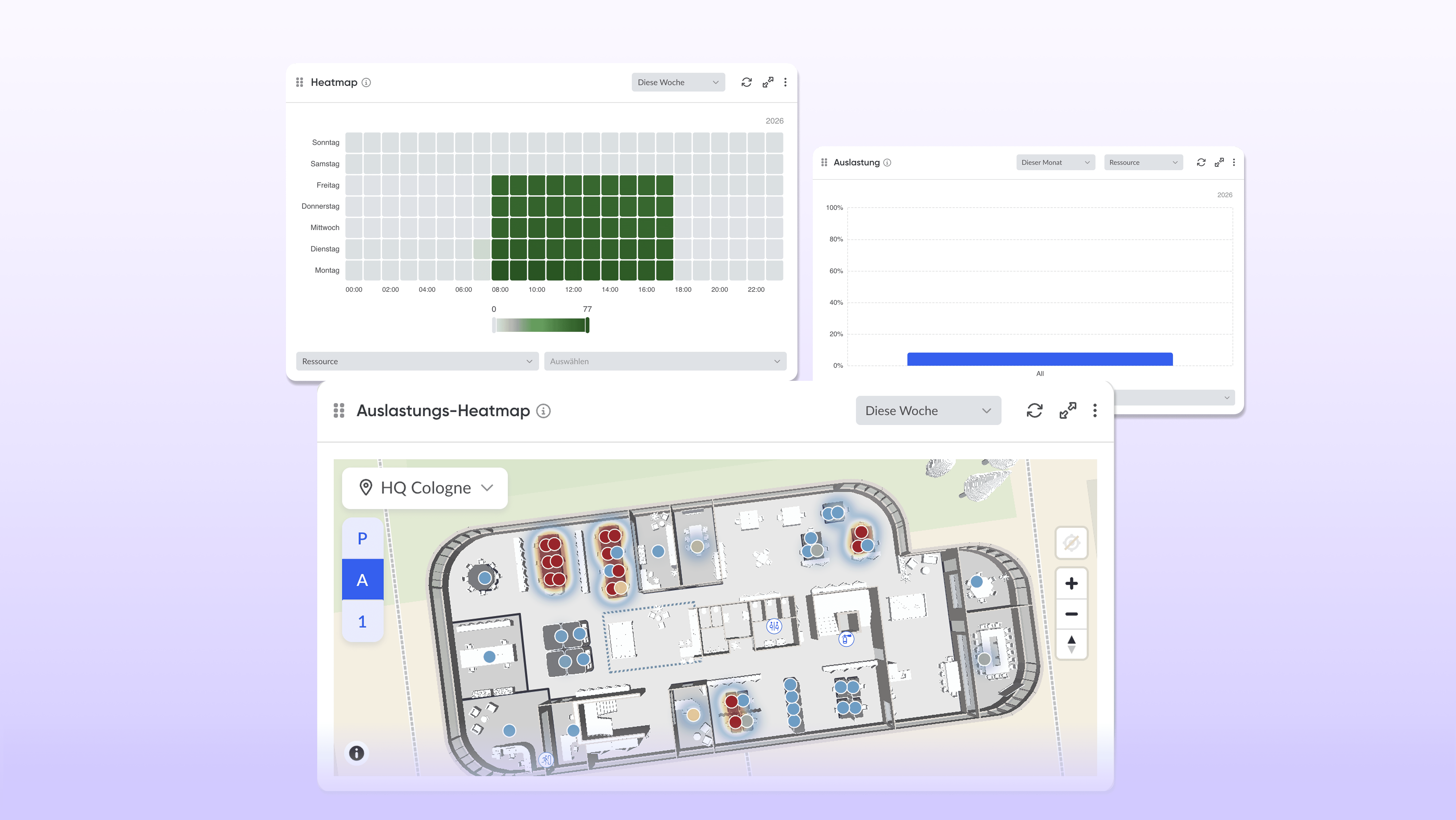
The analytics dashboard in anny analyzes booking data to show how heavily individual rooms, floors, and resource types are actually used. The core is the occupancy heatmap: It visually shows, in color, which areas are heavily or lightly occupied at different times – filterable by time of day, day of week, and quarter. Dark red means chronic overload, light green means persistent vacancy. At a glance, you can see where action is needed.
In practice, typical insights might look like this:
Area | Occupancy Monday | Occupancy Friday |
|---|---|---|
Conference Room A | 90% (09–13) | under 10% |
3rd floor total | 18% | 12% |
East Desk Zone | chronically overbooked | moderate |
From patterns like these, concrete actions can be derived immediately:
Permanently empty floors → review partial termination or subletting of leased space. At 500 m² and €15/m²/month, that adds up to as much as €90,000 in annual savings.
Unevenly booked rooms → repurpose meeting rooms as project zones or focus workspaces
Chronically overloaded areas → targeted expansion or redistribution of capacity
What used to rely on gut feeling or time-consuming manual counts becomes a reliable, data-driven basis for decision-making with anny—equally transparent for management and sustainability reporting.
Conclusion: Less waste, more control — with anny
Most office buildings waste energy not because of neglect, but because of a lack of visibility. With booking-driven IoT automation, you as a facility manager can finally see exactly what is really being used, when and where. And you can control, switch, and save precisely where it matters.
anny brings everything together on one platform:
Booking management for rooms, desks, parking spaces, and equipment
Shelly integration for automated, booking-driven lighting and energy control
Smart lock integrations with NUKI, Salto KS, Tapkey, dormakaba, and more for digital access control without key chaos
Analytics & occupancy heatmap for data-driven space and investment decisions
The result: fewer manual interventions in day-to-day operations, demonstrably lower operating costs, and a reliable data foundation – for your internal reporting just as much as for sustainability goals.
If you want to see what that could look like for your building, start with a free demo: Book a demo.