
Aug 19, 2026
Desk Sharing Company Agreement: Legally Compliant Implementation and Co-determination
8 min.

The Key Insights
Operational agreements for desk sharing are required in codetermined areas according to § 87 BetrVG.
The Regional Labor Court Baden-Württemberg recognized partial codetermination obligations in 2024 regarding regulations on personal belongings and dual allocation of spaces.
A Clean Desk Policy and IT booking tools may trigger additional codetermination rights.
Early notification of the works council according to § 90 BetrVG is legally mandatory.
Case law continues to evolve - case-by-case examination remains crucial.
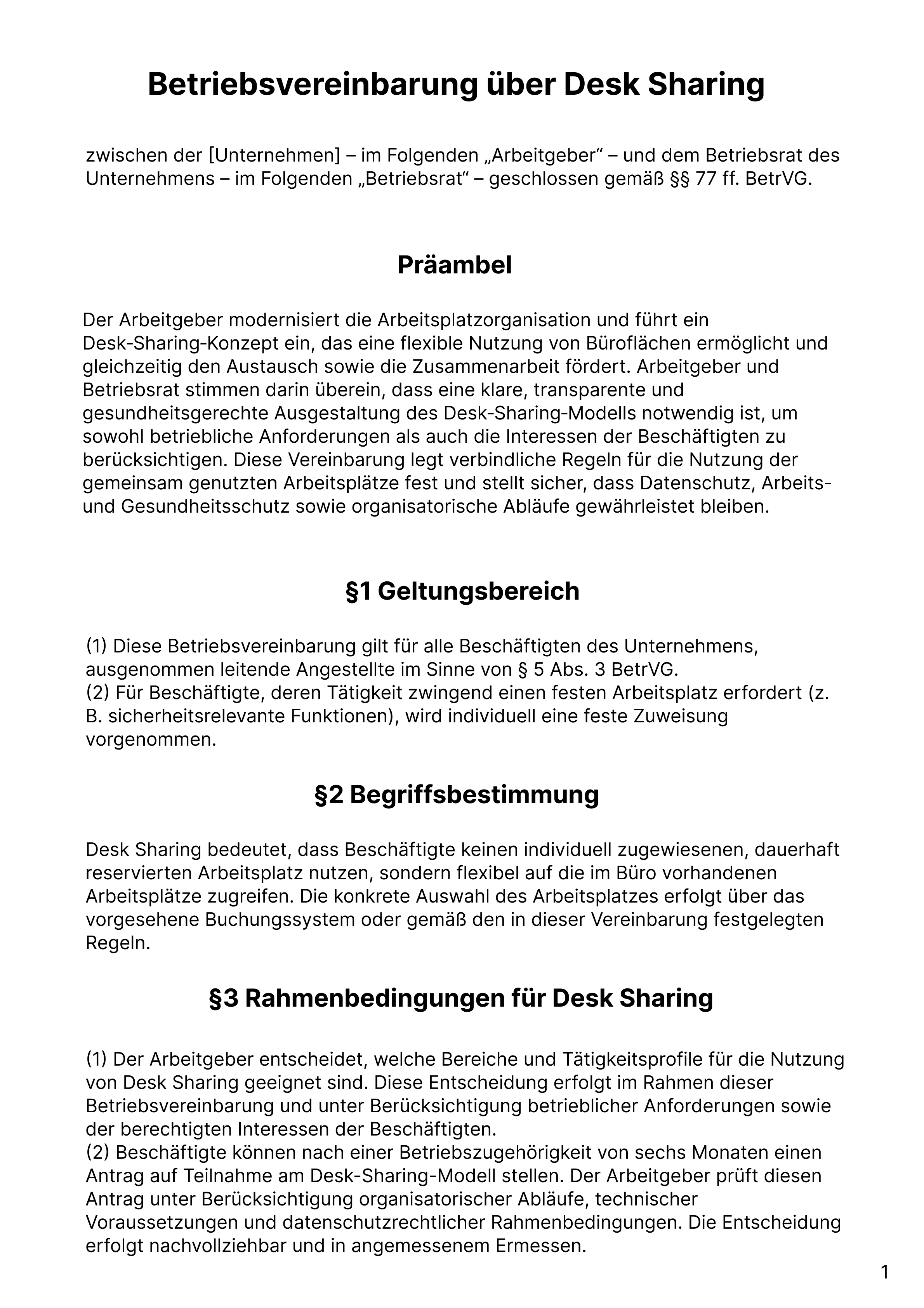
Download the company agreement
Enter your email to receive the document.
What is Desk Sharing and when is a company agreement necessary?
Desk Sharing describes a modern office concept where employees do not have permanently assigned workspaces but instead share workstations based on availability. Typically, for example, there are 80 workstations available for 100 employees, with booking facilitated through digital systems. This flexibility allows companies to achieve significant cost savings on office space and energy expenses – on average, about 30%.
The question regarding a works agreement cannot be answered universally. What matters is whether the planned desk sharing model affects areas subject to the co-determination of the works council according to the Works Constitution Act. While the pure organization of workplaces is often classified as work behavior, accompanying measures like Clean Desk Policies or monitoring systems can trigger co-determination rights.
The topic is gaining importance especially in the context of New Work and hybrid working models. Many companies view flexible workspaces as a cornerstone of modern work culture, but they must consider the rights and needs of their employees.
Legal Foundations of Codetermination
The legal assessment of desk sharing concepts is primarily based on co-determination rights under the Works Constitution Act. It is important to distinguish between different circumstances that establish various rights and obligations.
§ 87 BetrVG: Order and conduct within the company
The central paragraph for company agreements on desk sharing is § 87 BetrVG. It grants the works council co-determination rights in various areas:
§ 87 Subsection 1 No. 1 BetrVG: Co-determination on issues of workplace order and employee conduct. This involves what is known as conduct order, meaning rules for cohabitation in the workplace that don’t directly concern work performance. Typical examples are clean desk policies that regulate the handling of personal items at the workplace.
§ 87 Subsection 1 No. 6 BetrVG: Co-determination in the introduction and use of technical facilities that serve to monitor behavior or performance. Digital booking systems for desk sharing may fall under this if they collect data on work behavior or attendance times.
§ 87 Subsection 1 No. 7 BetrVG: Co-determination in health protection. This becomes relevant when changing workstations pose special requirements for ergonomics or risk assessments.
The distinction between co-determination-required conduct order and co-determination-free work behavior is often difficult in practice and is not uniformly assessed by the courts.
§ 90 BetrVG: Employer's duty to inform
Regardless of specific co-determination rights, § 90 BetrVG obliges the employer to inform the works council early and comprehensively—such as about planned changes in workplaces, workflows, or the work environment. This duty to inform already applies in the planning phase and is intended to give the works council the opportunity to make proposals to protect the employees.
If this obligation is disregarded, injunction claims may arise, which can significantly delay the implementation of a desk-sharing concept.
§ 111 BetrVG: Operational changes
According to the jurisprudence of the Federal Labor Court, the introduction of desk sharing is generally not considered an operational change within the meaning of § 111 BetrVG. The situation is different if desk sharing is part of a larger restructuring—such as in cases of massive space reductions or relocations.
In the event of operational changes, the works council is entitled to timely consultation and possibly to negotiate a reconciliation of interests or social plan. This is especially relevant when desk sharing is introduced as part of larger reorganization processes.
Co-Determination Areas in Desk Sharing
The case law shows that it is not the Desk Sharing concept as a whole that is subject to co-determination, but rather individual areas that need to be viewed differently. This insight is important for negotiations between employers and works councils.
Regulations on Personal Belongings
In 2024, the LAG Baden-Württemberg decided that regulations dealing with personal belongings in the workplace are subject to co-determination under § 87 Abs. 1 Nr. 1 BetrVG. This particularly affects Clean Desk Policies, which determine:
Which personal items are allowed to remain at the workplace
How private photos, plants, or personal items should be handled
Regulations for the storage and disposal of left-behind items
The provisioning and use of lockers or other storage options
These regulations pertain to employee behavior and have a direct impact on workplace dynamics. They go beyond simple work organization and therefore require a works agreement.
IT Booking Systems and Monitoring
Modern Desk Sharing systems, like anny, collect extensive data on workspace usage. If these systems are used to monitor employee behavior or performance, § 87 Abs. 1 Nr. 6 BetrVG applies. Co-determination is particularly required for:
Recording booking times and duration of presence
Analysis capabilities of individual usage patterns
Integration with other systems such as time tracking or access control
Automatic notifications or reminders
Data protection requirements under the GDPR intensify the need for clear regulations. Works agreements can serve as a legal basis for data processing and simultaneously protect the interests of employees.
Dual Use of Office Spaces
A particularly interesting aspect of the LAG Baden-Württemberg's decision concerns the dual use of office spaces. When areas are used both as workplaces and as break rooms or community areas, an overlapping usage arises that affects workplace dynamics.
This flexible use of offices requires regulations for:
Behavioral standards in multipurpose areas
Prioritizing competing claims of use
Noise levels and consideration in mixed zones
Cleaning and maintenance of flexible areas
The court saw this as a matter requiring co-determination since the type of space usage directly impacts the work environment and employee behavior.
Current Legal Judgments on Desk Sharing Works Agreements
The case law regarding desk sharing is developing dynamically and shows different evaluations by the labor courts. This development reflects the complexity of the topic and underscores the need for careful legal examination on a case-by-case basis.
State Labor Court Baden-Württemberg (2024): Partially subject to co-determination
The decision of the State Labor Court Baden-Württemberg from October 2024 marks an important milestone in case law on desk sharing. The court evaluated a comprehensive desk sharing concept in a differentiated manner and recognized different co-determination rights for various sub-areas:
Areas subject to co-determination:
Clean desk policy and regulations concerning personal belongings
Dual designation of office spaces as work and communal areas
Technical monitoring possibilities through booking systems
Areas not subject to co-determination:
General introduction of flexible workstations
Technical equipment of the workstations
Pure work organization without behavioral rules
The court ordered the establishment of a conciliation committee for the disputed points, which shows that even with partial agreement, there may still be a need for clarification. This decision sets a precedent for similar cases and offers guidance for other companies.
State Labor Court Düsseldorf: Introduction without co-determination
In another case, the State Labor Court Düsseldorf evaluated desk sharing as pure work behavior without the co-determination right of the works council. The court argued that flexible workstation usage is closely connected to work performance and therefore falls within the employer's directive authority.
This case law highlights the different evaluation approaches of the courts and clarifies that the specific design of the desk sharing concept is decisive. While pure work organization is often not subject to co-determination, accompanying regulations can trigger co-determination rights.
Labor Court Frankfurt: Participation required
The Labor Court Frankfurt granted a works council provisional legal protection and prohibited the introduction of desk sharing without prior involvement. This decision emphasizes the importance of information and consultation rights under § 90 BetrVG, even if no co-determination obligation exists.
The decision also shows the practical risks for employers who do not involve the works council in a timely manner. Injunctive claims can significantly delay projects and incur additional costs.
Content of a Desk Sharing Company Agreement
A legally compliant company agreement for desk sharing should cover all co-determination aspects while creating practical regulations for everyday work. The following areas have proven to be particularly important in practice.
Principles and Objectives
The first section of a company agreement should clearly define the company's desk sharing concept and state the goals pursued:
Definition and Scope:
Detailed description of the desk sharing model
Affected areas and departments
Exceptions for certain workplaces or employee groups
Relation to existing workplace regulations
Objectives:
Cost savings through efficient space utilization
Increasing flexibility for employees
Promoting teamwork among teams
Adaptation to hybrid work models
Balancing Interests:
Protection of employee interests
Consideration of special needs (severely disabled, pregnant women)
Ensuring ergonomic standards
Maintaining privacy and data protection
Workplace Distribution and Booking System
The technical implementation of desk sharing requires clear regulations on the booking procedure and workplace distribution:
Booking Procedure:
Available booking times and deadlines
Priority rules in case of bottlenecks
Cancellation options and deadlines
Procedures for technical problems
Workplace Equipment:
Standard equipment of all desk sharing workplaces
Ergonomic minimum standards
IT equipment and peripherals
Special equipment for specific needs
Special Regulations:
Long-term bookings for project work
Team workstations for group work
Quiet zones for focused work
Regulations for field staff
Clean Desk Policy and Orderly Rules
One of the most common points of contention in desk sharing company agreements are the regulations on handling personal belongings:
Tidying Duties:
Obligation for complete clearance when changing workplaces
Tolerated personal belongings during use
Handling of forgotten items
Cleaning and disinfection after use
Storage Options:
Provision of lockers or roll containers
Size and equipment of storage options
Access regulations and key management
Regulations for vacation time
Sanctions:
Warning in case of repeated violations
Temporary exclusion from desk sharing
Cost coverage for special cleanings
Escalation procedures in case of conflicts
Data Protection and Surveillance
The use of digital booking systems requires comprehensive data protection regulations:
Data Collection:
Type and scope of collected data
Purpose of data processing
Legal basis under GDPR
Storage duration and deletion deadlines
Evaluations and Controls:
Permissible statistical evaluations
Prohibition of individual performance assessments
Anonymization and pseudonymization
Rights of the affected individuals
Technical Security:
Protection against unauthorized access
Encryption and backup procedures
Logging of system accesses
Reporting procedure for data protection violations
anny as desk sharing software meets the highest data protection and security requirements.
Ergonomics and Occupational Safety
Flexible workplaces place special demands on occupational safety:
Risk Assessment:
Special assessment for desk sharing workplaces
Consideration of changing users
Regular review and adjustment
Documentation and evidence
Ergonomic Standards:
Height-adjustable desks and chairs
Adjustable monitors and lighting
Ergonomic input devices
Footrests and other aids
Training:
Introduction training for new desk sharing users
Regular refresher courses
Information about ergonomic settings
Contact person for problems
Negotiation Process and Conciliation Body
The success of a Desk Sharing implementation significantly depends on a constructive negotiation process between the employer and the works council. Early communication and transparent information can prevent many conflicts.
Preparation for Negotiations
Careful preparation is the key to successful negotiations:
Early Involvement:
Informing the works council already in the planning phase
Joint needs analysis and goal definition
Involvement in pilot projects and test phases
Regular consultations during development
Data Collection:
Employee surveys on acceptance
Analysis of current workplace usage
Benchmarking with other companies
Cost-benefit analyses
Legal Preparation:
Examination of co-determination obligations in the specific case
Analysis of comparable court decisions
Consultation with labor law specialists
Development of alternative regulatory approaches
Points of Contention and Compromise Solutions
In practice, similar conflict areas often emerge, for which proven compromise solutions exist:
Common Points of Contention:
Scope of the Clean Desk Policy
Data collection through booking systems
Exceptions for certain employee groups
Sanctions for rule violations
Proven Compromises:
Gradual introduction with evaluation phases
Flexible regulations for different areas
Trust-based working hours instead of strict control
Co-determination in system selection
Evaluation and Adjustment:
Regular review of the agreement
Adjustment options under changing conditions
Feedback procedures for employees
Joint success assessments
Arbitration Board as a Last Resort
If the employer and works council cannot reach an agreement, an arbitration board decides on the disputed points:
Requirements:
Failure of direct negotiations
Co-determined matter
Request by one of the parties
Formation of a parity arbitration board
Procedure:
Appointment of assessors by both sides
Selection of a neutral chairperson
Hearing of both parties
Binding ruling of the arbitration board
The costs of an arbitration board are substantial and the process is time-consuming. Therefore, all possibilities of an amicable solution should be exhausted before this route is taken.
Practical Implementation Without Works Council
Companies without a works council have more flexibility in designing desk sharing, but should still establish legally compliant regulations and consider the interests of their employees.
Employment Contract Regulations:
Inclusion of desk sharing clauses in employment contracts
Additional agreements for existing employment relationships
Clear rules on rights and obligations
Revocation reservations for adjustments
Voluntary Agreements:
Employee involvement in development
Voluntary participation in desk sharing
Regular feedback sessions
Adjustments based on experiences
Legally Compliant Documentation:
Written policies and procedures
Documentation of training
Proof of information on data protection
Logging of changes
Data Protection Aspects:
Consent of employees for data processing
Transparent information about data usage
Appointment of a data protection officer
Regular data protection impact assessments
Suitable Desk Sharing Software
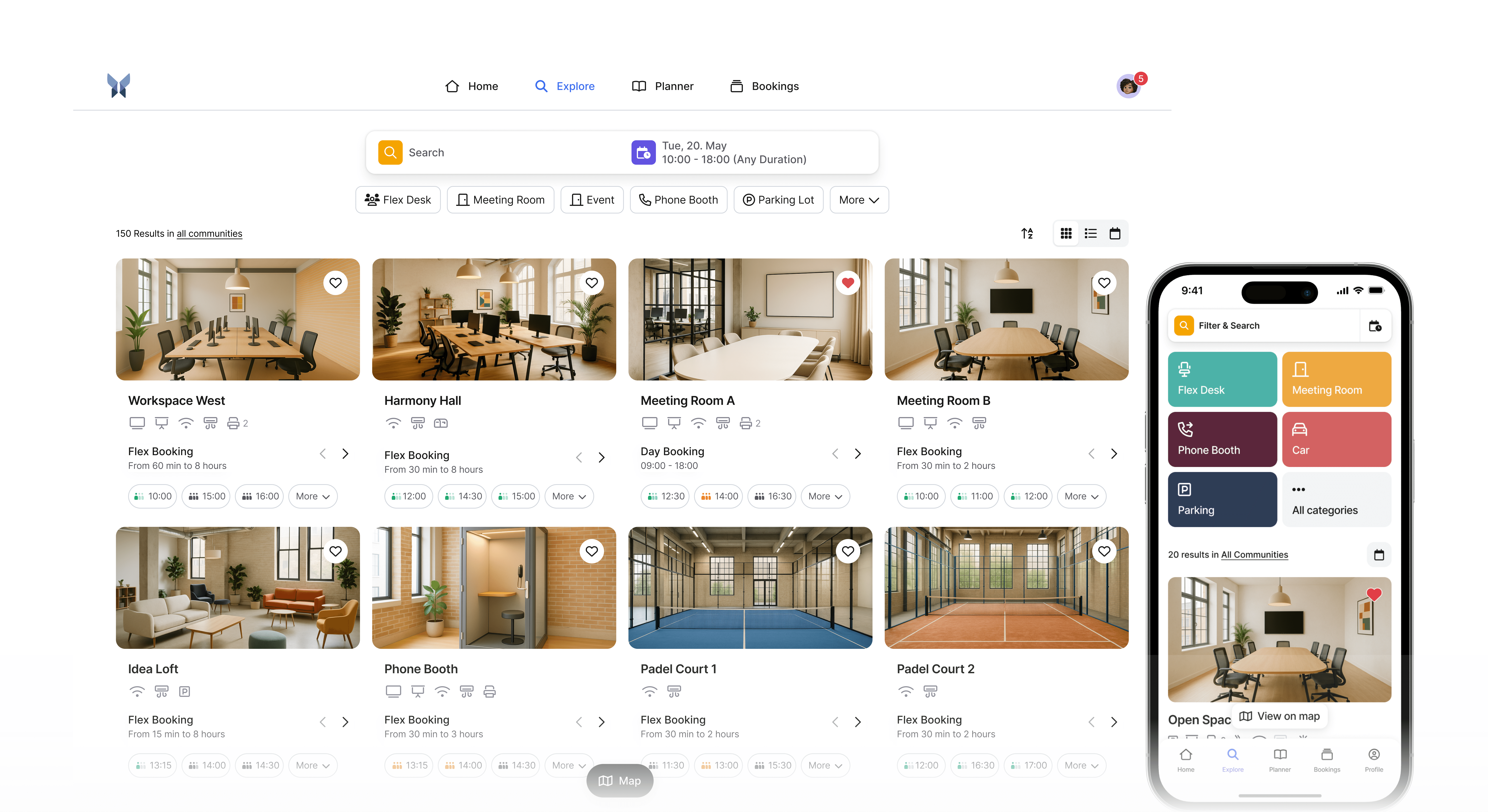
For the successful implementation of a desk sharing concept, a reliable and user-friendly software solution is crucial. anny offers a modern platform as desk sharing software that helps companies in the flexible management of their workplaces. With anny, employees can conveniently book available desks in real-time, optimizing the use of office spaces and increasing flexibility.
The software allows easy integration into existing IT infrastructures while taking into account important aspects like data protection and user-friendliness. Through features such as the display of workplace equipment, management of access rights, and support of clean desk policies, anny helps meet the requirements of works councils and employees.
Particularly advantageous are the clear booking processes and the ability to accommodate the individual needs of employees, such as by reserving ergonomic workplaces or special working areas. This way, anny not only supports efficient space utilization and cost savings but also enhances the well-being and productivity of employees within the framework of modern New Work concepts.
FAQ
Is it necessary for every company to establish a Desk Sharing Works Agreement?
No, a works agreement is only necessary if the desk sharing concept involves areas subject to the co-determination of the works council. This depends on the specific design - particularly on accompanying measures such as Clean Desk Policies or monitoring systems. Companies without a works council can generally introduce desk sharing independently but should consider legal aspects of employment.
Can the works council completely prevent the introduction of desk sharing?
The works council cannot fundamentally prevent the introduction of desk sharing, as the organization of work falls within the employer's right to direct. However, in areas requiring co-determination, they may demand a say and potentially bring about the involvement of a reconciliation board. In practice, constructive cooperation usually leads to acceptable compromises for all parties involved.
What role does company size play in co-determination?
The co-determination rights according to § 87 BetrVG apply regardless of company size, provided there is a works council. However, larger companies may be more frequently affected by co-determination rights due to more complex structures and extensive desk sharing concepts. The legal precedent is based on the specific design, not on the size of the business.
How long does the negotiation process for a works agreement take?
The duration strongly depends on the complexity of the desk sharing concept and the willingness to cooperate from both sides. Simple agreements can be completed in a few weeks, while complex projects may take several months. Involving a reconciliation board significantly extends the process - often by another 6-12 months.
What happens in case of violations of the works agreement?
Violations of works agreements can have legal consequences, as they act directly and mandatorily like collective agreements. Depending on the severity, warnings, dismissals, or claims for damages may follow. At the same time, employees have the right to enforce compliance with the agreed regulations and can assert this in court if the employer violates them.