

Amira van Weegen
Junior Marketing Manager
October 23, 2025
Creating a Successful Hybrid Work Policy: Guide and Best Practices
5 mins

How to Create Effective Hybrid Work Policies
How to create a hybrid workplace policy that works?
Such a policy defines how employees transition between the office and home office. In this article, you'll learn what a hybrid workplace policy is, how to create one, and the benefits it offers.
Key insights at a glance:
Hybrid workplace policies combine in-office and remote work to enhance flexibility and efficiency.
Key elements include clear work schedules, communication standards, and location rules to prevent misunderstandings.
Technology and continuous adjustment of policies are crucial for the successful implementation of hybrid working models.
What is a hybrid work policy?
A hybrid work policy is a guide for hybrid working and dictates where, when, and how employees work. Unlike purely remote work, where all tasks are performed from home, a hybrid work model combines both remote and office work. These policies are crucial for setting clear structure and expectations.
A hybrid work model allows companies to leverage the benefits of both worlds: in-office personal interactions as well as the flexibility of remote work. It's not only a matter of work locations, but also of work methods and hours, which must be detailed in the policy. Here are some tips to successfully transition to hybrid working forms. The model offers numerous opportunities to optimize workflows and the various work models as well as changes.
The benefits are diverse, from cost savings to increased employee satisfaction.
Why a Hybrid Work Policy is Important
Hybrid work policies offer companies the opportunity to combine the benefits of office and remote work to increase flexibility and efficiency. A clear and transparent policy ensures that misunderstandings between employees and employers are avoided and smooth operations are assured. Hybrid work policies also ensure that the needs of all parties involved are taken into account.
A well-thought-out hybrid work policy is also crucial for employer attractiveness. Companies that offer flexible and transparent work arrangements to their employees attract top talent and enhance employee satisfaction. It is important to tailor the policy to the specific needs of the company to achieve the best outcomes.
Core Elements of a Successful Hybrid Work Policy
A successful hybrid work policy includes several core elements that are essential for effective implementation. These include, among others:
eligibility criteria
the work schedule
communication standards
rules for the workplace location
These elements must be clearly defined and tailored to the specific needs of the organization.
The design of a hybrid work policy should be customized to meet different requirements. A well-structured work schedule and clear rules regarding workplace locations are as important as the expectations for team communication. The structures of work hours should also be considered.
HR teams should invest ample time in the design and implementation to meet the organization's needs.
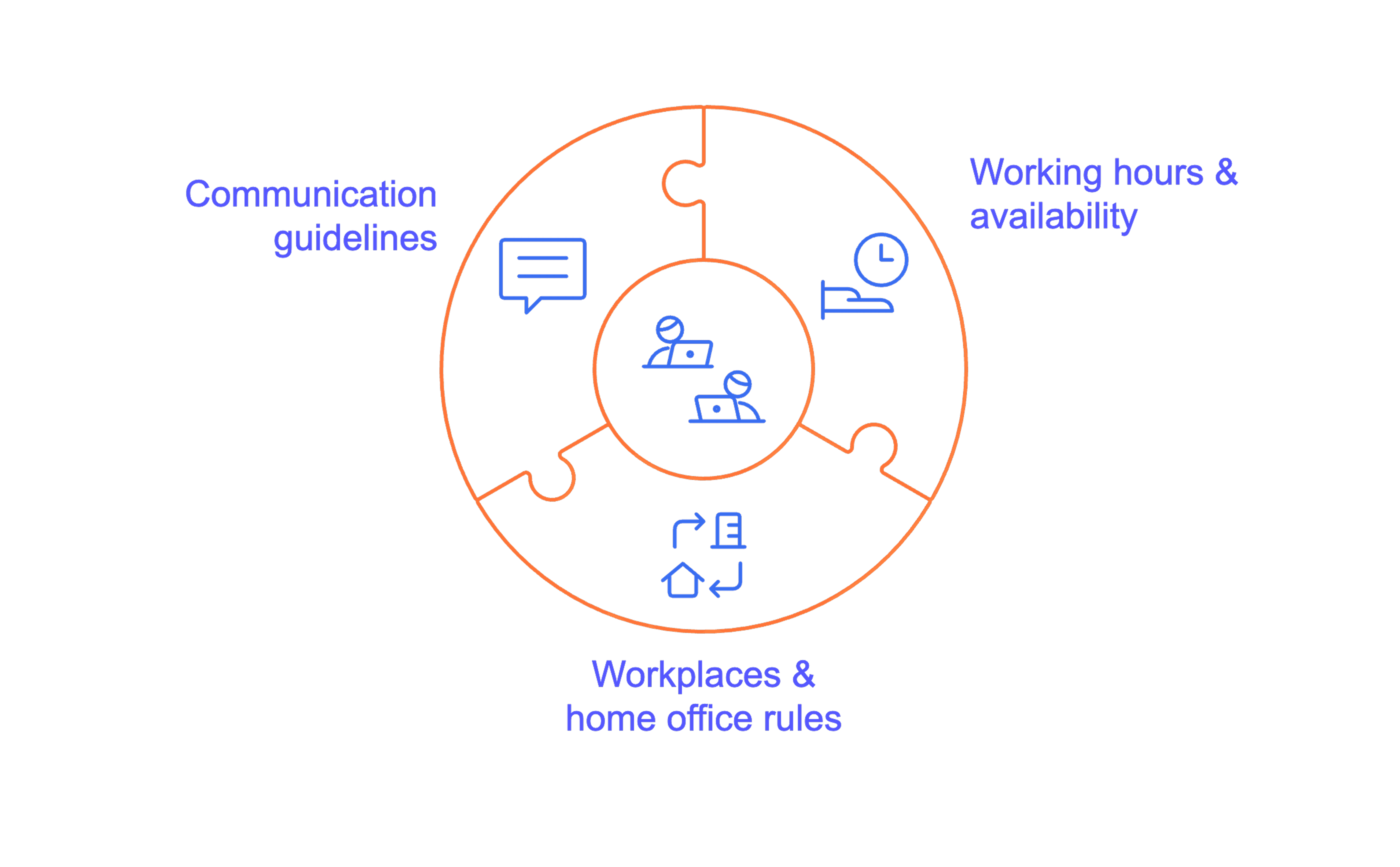
Working Hours and Availability
An important aspect of the hybrid work policy is the establishment of work schedules that provide employees with flexibility and a better work-life balance. This can be achieved through the following measures:
Clear definitions of working hours
Approval clauses that specify who approves the work schedules
Establishing how often work schedules are reviewed
Practice examples show how companies implement this: Google requires employees to work three days in the office and two days remotely. Such arrangements promote flexibility and increase employee productivity.
Workplaces and Home Office Rules
Hybrid work policies should also include clear regulations for workplace locations and working environments. Approved workplaces can include home offices, coworking spaces, and other third-party work locations. Companies should consider aspects such as accessibility and the type of work performed.
Some policies require employees to be located in the region where they operate to fulfill their role. The choice of workplace can also be influenced by employees' residential and family circumstances.
Communication Guidelines
Clear communication guidelines are crucial for the success of a hybrid work model. Minimum standards for communication between leaders and teams should be established to ensure clarity and efficiency. Transparent communication channels help ensure that all employees are treated equally, regardless of their workplace location.
Technology and Equipment
Technology and the right equipment are crucial for a successful hybrid working model. IT security is particularly important in this context: companies must ensure that sensitive data remains protected even outside of the office.
Key security measures include:
Strong and secure passwords
Two-factor authentication (2FA)
Using a VPN for secure access to company networks
These precautions build trust, minimize security risks, and ensure that employees can work safely and efficiently from home.
The IT department should offer regular training on current security threats and ensure employees can make the most of the provided technology. Companies should provide laptops and other equipment such as monitors to support the hybrid work style. A stable internet connection at the workspace is also crucial to avoid interruptions.
Choosing the right tools for hybrid teams should prioritize the effectiveness of collaboration. With the right technologies and equipment, companies can significantly increase the productivity and satisfaction of their employees.
Health, Safety, and Well-being
A well-designed hybrid work policy can help companies reduce costs, boost employee satisfaction, and strengthen their commitment to the company. Flexible working hours and locations enable a better work-life balance and significantly contribute to the wellbeing of employees.
Studies show that hybrid working can enhance mental wellbeing. It offers more flexibility, reduces stress from commuting times, and minimizes office distractions. More than half of the respondents stated that their mental health improved through hybrid work models.
Despite these advantages, social interaction remains a central factor. Personal meetings strengthen the sense of belonging and prevent isolation when working from home. Companies should therefore actively promote measures that enable empathy, team spirit, and supportive onboarding. This creates a healthy, motivating work environment where hybrid teams can thrive long-term.
Equality and Protection from Presence Bias
Hybrid work opens up new opportunities for flexibility and balance, but also poses risks for unconscious bias. One of the most common pitfalls is the so-called Presence Bias: the tendency to perceive employees who are more often in the office as more committed or higher-performing. This unconscious mindset can lead to employees who work more frequently remotely being disadvantaged in promotions, projects, or performance evaluations.
To prevent such biases, companies should establish clear, performance-based evaluation criteria that focus on outcomes rather than physical presence. Leaders play a crucial role: they must learn to evaluate performance objectively, regardless of location. Regular training to raise awareness of Presence Bias and unconscious prejudices is therefore essential.
Effective diversity and inclusion management also supports equality in the hybrid work environment. This includes binding measures in the hybrid work policy, such as transparent promotion processes, equal access to information and career opportunities, and protective mechanisms against discrimination.
Only when equality is actively promoted and Presence Bias is consciously addressed can hybrid work realize its full potential: a fair, inclusive, and performance-oriented work environment for all employees.
Implementation and adaptation of the hybrid work policy
The introduction of a hybrid work policy is a strategic process that requires planning, communication, and collaboration.
Important steps in the introduction:
Engage stakeholders: Consider different perspectives (e.g., leadership, employees, IT, HR) to create a holistic policy.
Conduct a pilot phase: Test the concept with selected teams to identify strengths and weaknesses early.
Ensure communication: Clearly explain the goals, benefits, and expectations of the hybrid model.
Integrate feedback: Regular feedback loops and employee surveys help understand needs and continually improve policies.
Adjustment and further development:
A hybrid work policy should remain dynamic. As work methods, technologies, and team structures evolve, regular review and adjustment are crucial.
Measuring success:
Use SMART goals (specific, measurable, achievable, realistic, time-bound) to assess the effectiveness of the policy. This helps in understanding whether the measures truly lead to more productivity, satisfaction, and efficiency.
Desk sharing as the key to a successful hybrid work culture
A hybrid work policy can only be fully effective if office organization is flexible enough to support it. This is where desk sharing comes into play: it allows employees to abandon fixed workspaces and book a spot depending on presence, projects, or teams.
Why desk sharing is so important:
Adaptation to variable office occupancy: In hybrid work models, not everyone is in the office at the same time. Desk sharing prevents valuable office spaces from remaining unused and ensures efficient space utilization.
Cost efficiency: Fewer required workspaces mean lower rental, energy, and equipment costs, a clear advantage in times of rising operational expenses.
Flexibility and personal responsibility: Employees can decide for themselves when and where they work. This strengthens self-organization and boosts satisfaction.
Promotion of collaboration: Rotating neighbors create new impulses and interdisciplinary contacts that foster creativity and knowledge exchange.
How anny integrates Desk Sharing and hybrid work
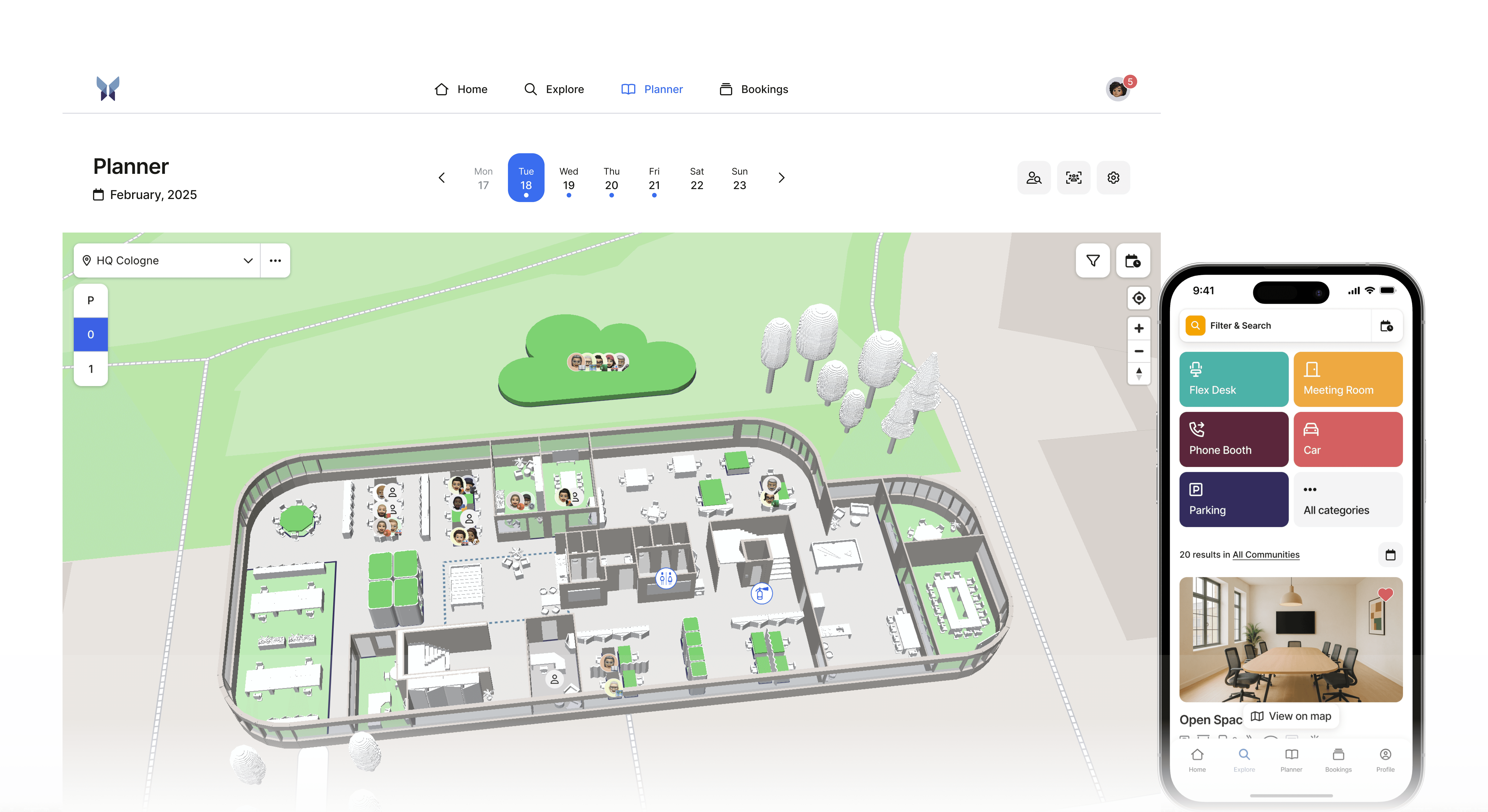
For desk sharing to work smoothly, clear structures and easy booking processes are essential. This is where anny comes in:
The hybrid workplace management platform by anny enables companies to efficiently manage and book workstations, meeting rooms, or parking spaces, in a transparent and user-friendly manner.
With anny, companies benefit from:
Smart workspace booking: Employees can see in real-time which spaces are available and reserve them with just a few clicks.
Optimized space utilization: Real-time data helps in planning and utilizing office spaces more effectively.
Integration of existing tools: Seamless integration with calendars like Google or Outlook facilitates daily organization.
Improved team collaboration: Teams can collaboratively plan who will be in the office when, coordinating hybrid work efficiently.
Desk sharing is not just an organizational concept, but a strategic element of successful hybrid work policies, and with anny, its implementation is simple, transparent, and future-proof.
If you're ready to implement your hybrid office concept, book a free demo with anny now: book here.





" height="38px" id="bH388uk2E" transform="translate(1 1)" width="118.00000395534607px"/></svg>)