March 6, 2026
Hybrid Work & Employee Satisfaction: How Social Connection Makes the Difference
6 min

Key Insights
Hybrid work has been established in the DACH region since 2020, offering more flexibility, yet it significantly reduces spontaneous interactions and informal exchanges.
Social connectivity, team cohesion, and mental health are key drivers of employee satisfaction, engagement, and long-term retention.
The office is transforming from a daily workplace into a conscious meeting and collaboration space that makes culture tangible.
Encounters do not happen automatically—they require structure, transparency, and clear agreements between teams.
Thoughtfully designed desk sharing can help coordinate in-office days and bring teams together in the hybrid environment.
Introduction: How Hybrid Work Is Changing Us
In many companies, hybrid work has become a standard organizational form: Employees switch between home office and office, making their work location more flexible than before.
This flexibility offers clear advantages. Employees can structure their workday more individually, complete focused tasks where they are most productive, and reduce commuting times. Many experience more autonomy and a better balance between work and private demands.
At the same time, the social everyday life in the company changes. Spontaneous hallway conversations become rarer, joint coffee breaks do not occur automatically anymore, and many interactions shift to planned digital meetings. The exchange continues – but it often feels more structured and less casual.
This is where a central question of hybrid cooperation becomes apparent: How do teams stay connected when they meet less often by chance?
Successful teams do not function solely through task lists, project plans, or meetings. They are formed through relationships, trust, and shared experiences. Social well-being – the feeling of belonging and social connectedness – becomes a crucial factor in determining whether hybrid work will strengthen motivation, collaboration, and employee satisfaction in the long term.
When Flexibility Leads to Social Distancing
Flexible working models not only change where people work, but also team dynamics. Without deliberate design, physical distribution can gradually reduce social contact in everyday work. Fraunhofer IAO describes this phenomenon as „social erosion“, the gradual loss of informal relationships that often happens unnoticed.
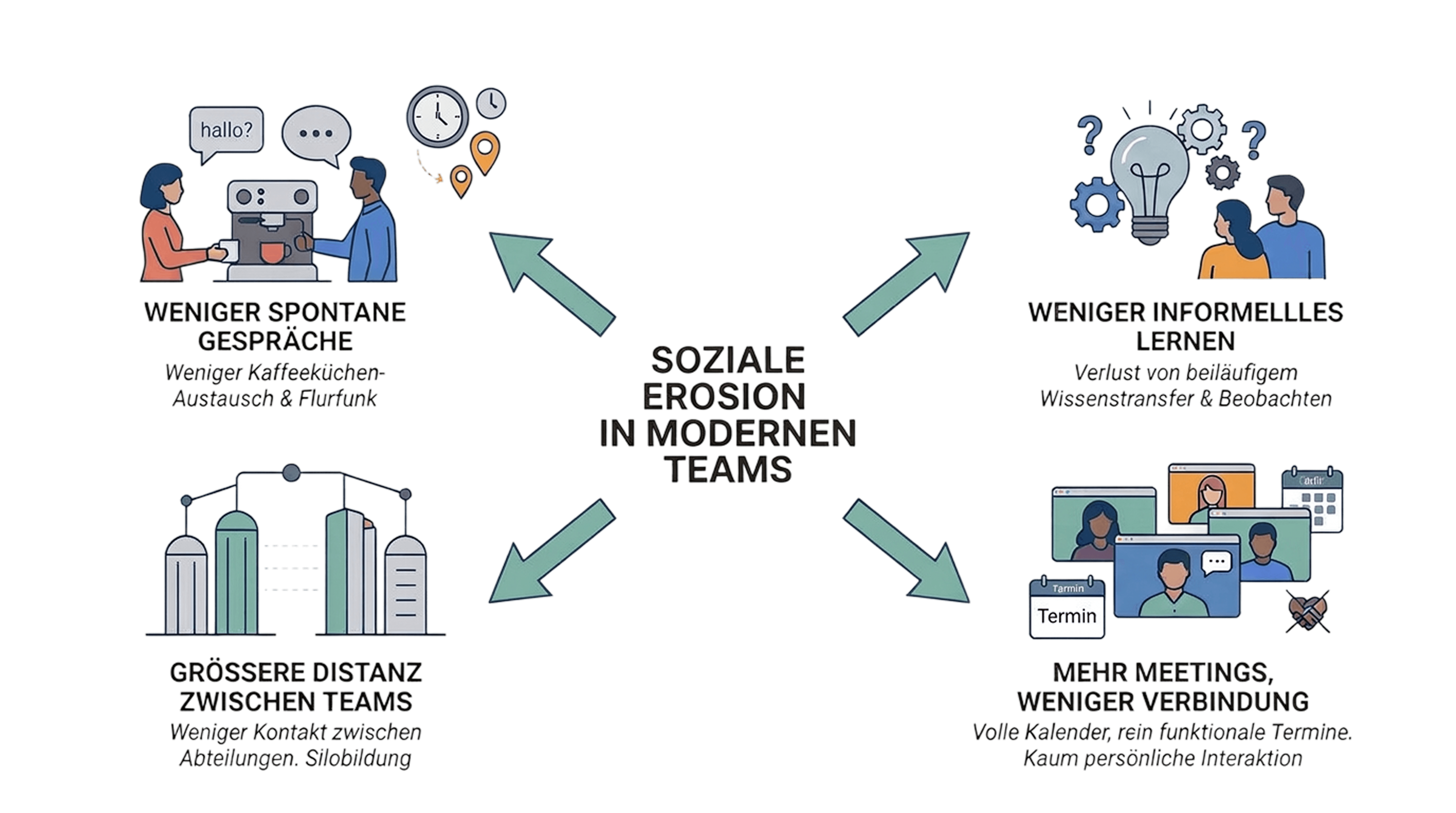
In day-to-day operations, this shows up in many organizations in similar ways:
Less spontaneous conversation
Quick chats between meetings or casual exchanges in the break room become rarer when colleagues work at different times or in different locations.Less informal learning
Much of knowledge is not created in meetings, but in passing exchanges: through quick questions, solving problems together, or observing how others work. This form of learning decreases noticeably in distributed work environments.Greater distance between teams
Departments or project groups that used to work in the same office area lose contact faster. Without regular in-person touchpoints, silos form more easily.More meetings, less connection
Calendars are often full, yet many meetings remain purely functional: status updates, decisions, task allocation. There is rarely room for personal interaction.
The New Role of Offices in Hybrid Work
The role of the office has fundamentally changed. In the past, the office was the place where everyone worked daily, often obligatorily, usually with a fixed desk. Today, it is a consciously used meeting and collaboration space.
From Workplace to Experience Space
Many employees do focused individual work at home—where they can work undisturbed and concentrate. They come to the office to meet people, think together, and experience company culture.
This concretely manifests in changed usage patterns:
Activity | Preferred Location |
|---|---|
Focused individual work | Home office |
Team workshops, brainstorming sessions | Office |
Project kick-offs, onboarding | Office |
1:1 conversations, one-on-one with leaders | Office or hybrid |
Informal gatherings (joint breakfast, after work) | Office |
Routine meetings, status updates | Often remote |
The office is most effective when it enables encounters and conveys psychological safety. Employees want to feel welcome, experience visible culture, and perceive their team as part of their working environment.
New Responsibilities for HR and Workplace Management
This change also shifts the responsibility of HR, People & Culture, and Workplace Management. The way offices are used requires less space management and more experience design. It's no longer just about managing square meters but about creating spaces where teamwork, collaboration, and connectedness can emerge.
The office becomes the centerpiece of hybrid working when it is properly designed.
Encounters don't happen by chance
Many companies assume that the office will naturally fill up once they open it—and that connections will automatically form. This assumption often proves to be a misconception in practice.
The Problem of Invisible Presence
Specific scenarios from daily work life highlight the issues:
An employee comes motivated to the office only to find that her entire team is working remotely. She spends the day alone.
A new team member regularly uses the office but never meets the colleagues who are supposed to onboard them—because their in-office days aren't visible.
Two groups on a project both work in a hybrid mode but come on different days. The spontaneous hallway meetings that used to be commonplace no longer happen.
The result: The social function of the office fizzles out. Employees experience the office not as a place of encounter but as an empty space that offers little beyond what they have at home.
Encounters Need Structure
Transitioning to a functional hybrid working model requires intentional design. Meetings need structure:
Visibility: Employees and team members should know who is working where and when.
Clear Agreements: Teams should set joint in-office days—not as an obligation but as a conscious decision to promote unity.
Interaction-Friendly Spaces: Offices need zones that encourage interaction—not just silent individual workspaces.
For HR and workplace management, this means that policies, frameworks, and supportive solutions need to be established to ensure hybrid working is not left to chance. Only then can the office fulfill its new role as a place of connection.
Desk Sharing as an opportunity to reunite teams
Desk Sharing is already a reality in many companies. It was often introduced to reduce space and cut costs, understandable goals considering lower office occupancy. However, this perspective is too limited.
Changing Perspectives: Desk Sharing as a Social Tool
Desk Sharing can also be understood as a social organizational tool. Rather than being just a real estate issue, it can become an approach to reconnect teams in a hybrid work environment.
This can be achieved when Desk Sharing is consciously planned:
Shared Presence Days: Teams set specific office days – like “Every Wednesday is Marketing Day” or “Every second Thursday the project team meets on-site.”
Coordinated Seating Areas: Instead of random distribution, team members intentionally book seats next to each other.
Sprint-based Office Phases: Project teams use the office strategically for intensive collaboration phases.
Benefits for Team Cohesion and Well-being
When Desk Sharing is viewed socially, real opportunities arise:
Higher likelihood of spontaneous conversations and shared lunches
Brief chats in passing, which would be cumbersome online
Stronger team identification through regular personal encounters
Breaking down silos through temporarily mixed seating areas and community zones
At the same time, it holds true: Desk Sharing only contributes to a sense of togetherness and well-being when employees experience planning security and the ability to participate. If Desk Sharing is perceived as enforced control, it leads to frustration and rejection instead of connection.
How anny Desk Sharing becomes a social tool
Many organizations realize that desk sharing only works when bookings and coordination are easy, transparent, and fair for everyone. Without the right tools, coordination remains cumbersome and the opportunity to plan encounters is wasted.
Creating Transparency
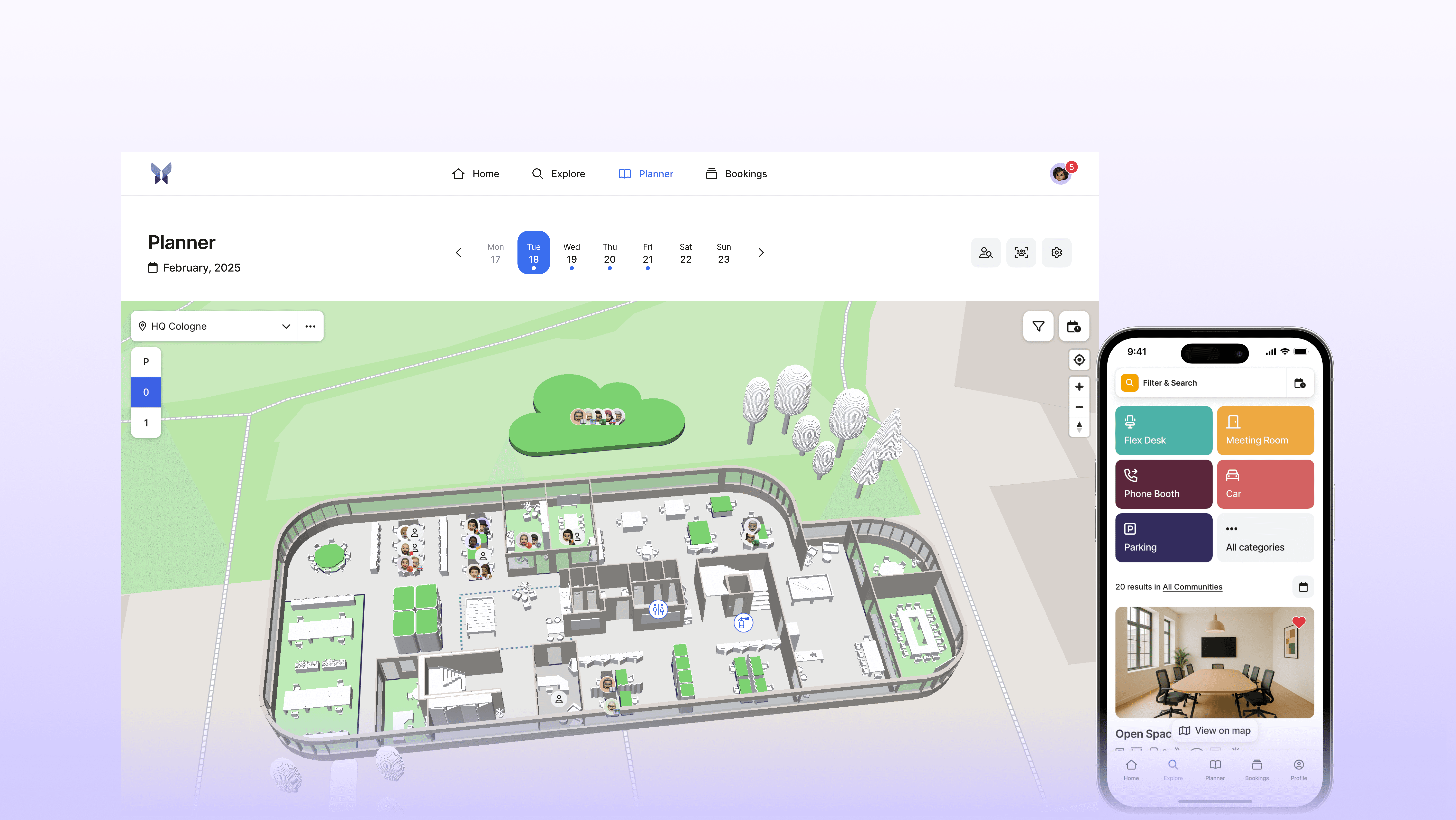
At anny, we see that transparency is the key to successful desk sharing. With our platform, employees can see who is in the office on which days, which desks and zones are available, and place themselves strategically.
This changes the dynamics: Instead of arriving to an empty office, employees know in advance whom they will meet. They can consciously decide on which days visiting the office makes sense for them – because their team is there, a project workshop is taking place, or they want to make new contacts.
Connecting Teams
With anny, teams can plan joint presence days. This works in several ways:
Set Team Days: The marketing team books a common zone every Wednesday. Everyone knows: Wednesday is meet-up day.
Booking Rules and Workflows: Organizations can define rules that reserve certain areas for teams or set minimum presence days.
Communities for Project Teams: Cross-location groups – such as chapters or communities of practice – can coordinate and organize targeted interactions through anny.
Orientation in the Office
Especially in larger environments or after relocations, orientation is important. With 3D floor plans, it's visible where team zones, project areas, or meeting zones are located. New employees can immediately find out when their onboarding buddies are in the office. Everyone can position themselves strategically near colleagues they collaborate with.
Practical Examples
In practice, the benefits become evident in concrete scenarios:
The sales team books a shared zone every Thursday for teamwork and informal exchanges.
New team members see through anny when their contacts are on-site and plan their first weeks accordingly.
Cross-location communities use anny to coordinate quarterly presence meetings.
Trust and Data Protection
A sensitive issue with any booking solution is data protection. anny is hosted in Germany and is GDPR-compliant. HR can use booking data for planning and utilization analysis without monitoring employees. The focus is on trust – not on control.
An office that reconnects
The Vision: Planned Encounters Rather Than Chance
Employees see who will be present before they even arrive. They consciously choose office days when their team is on-site or when they want to meet people from other departments. Upon arriving at the office, they encounter familiar faces, planned communities, and well-organized spaces.
Meeting rooms, project zones, and community areas work together. There is less organizational stress—no search for free spaces, no empty floors. Instead, there is more room for what truly matters: encounters, collaboration, shared ideas.
Recharge Instead of Just Being Present
In this vision, the office regains its value. It becomes a place where people experience their team, connect emotionally with the company, and recharge their energy. The process of coming in is no longer a duty, but a conscious decision.
Desk sharing and workspace management tools like anny are means to an end. The true goal remains: strengthen team cohesion, foster a sense of belonging, protect mental health. The objectives of HR, People & Culture, and Workplace Management merge: It's about people, not spaces.
Conclusion: Consciously Design Hybrid Work to be Social
Hybrid work is transforming social dynamics within organizations. The flexibility offers true opportunities—for productivity, for work-life balance, for talent acquisition. At the same time, there is the risk of isolation, alienation, and the gradual loss of cohesion.
Teams need intentional spaces and structures for interaction—both digitally and in person. The office can take on this role if it is not only open but also actively designed. Leaders, HR, and workplace management share the responsibility of ensuring that connectedness is not left to chance.
The office is valuable in the hybrid model when it allows people to experience their team, maintain relationships, and feel the culture. Thoughtful desk sharing—supported by a platform like anny—can help turn the office back into a place that brings people together.
The invitation is: to strategically consider social well-being. Not as a soft side issue but as the core of a work culture that navigates changes and retains employees in the long term.
FAQ: Hybrid Work, Desk Sharing, and Social Connection
How can HR specifically measure social connectedness in hybrid work?
In addition to traditional engagement surveys, HR teams can use short pulse checks monthly or quarterly that specifically inquire about the sense of belonging, team climate, and perceived support. These provide faster insights than annual surveys.
Additionally, qualitative formats are suitable: focus groups with different teams, retrospectives after project phases, or structured one-on-one meetings with new employees after 30 and 90 days. Usage data from workspace management tools — for example, how often teams are in the office on the same days — can provide supplementary clues, but do not replace direct conversations about well-being.
What role do leaders play in social well-being in the hybrid model?
Leaders are role models for presence culture. Their own behavior determines how consciously team days are lived and relationships are maintained. When leaders themselves are regularly in the office and actively initiate encounters, it signals to the team: presence is desired and valuable.
It is advisable to establish regular team rituals — such as weekly office days, joint check-ins, or lunch breaks in the office. Leadership programs should include topics such as psychological safety, remote leadership, and mental health to empower leaders for the new demands of hybrid teamwork.
How can employees be involved when new desk-sharing concepts are introduced?
Involvement increases acceptance. Organizations should collect feedback early — through workshops, surveys, or pilot areas with volunteer teams testing the concept. This way, problems are recognized early and solutions are developed together.
It is important to communicate clear guidelines: How many presence days are expected? How do bookings work? How are fairness and quiet workspaces ensured? Employees should have a say in defining team zones, presence days, and rules — this strengthens identification with the concept.
How can mental health be practically supported in the hybrid workday?
Concrete measures start with leadership: mental health should be embedded in leadership training. Internal or external counseling services — such as Employee Assistance Programs — offer low-threshold support. Open dialogue spaces where burdens are addressed can build trust.
Workload and meeting culture deserve regular review. Meeting-free afternoons or clear focus times can provide relief. Social opportunities — community formats, team days in the office, peer groups for specific topics — are important building blocks for prevention and resilience.
Is desk sharing also sensible for smaller companies?
Desk sharing is not linked to company size, but to the variability of use. Even teams with 20 to 50 people benefit from transparency and coordination in hybrid work. When not everyone is in the office simultaneously, shared project spaces, flexible use of meeting rooms, and coordinated team days help to better utilize available resources.
Lean, easy-to-use tools like anny can also help smaller organizations without setting up complex processes. The focus should be on simplicity and utility — not bureaucracy.