February 13, 2026
Hardly anyone comes to the office: How to change that – without rigid attendance requirements
7 mins.

Key Insights
The pandemic is long over, yet many offices remain conspicuously empty. While companies continue to pay rent for spaces that seem deserted on Mondays and Fridays, employees have become accustomed to the flexibility of working from home. This article shows how leaders, office managers, and HR managers can bring life back to their offices without relying on rigid attendance requirements.
The essentials at a glance:
Low occupancy is the new normal: Since 2022/2023, an average of only 20–40% of workstations are occupied in many companies, despite lifted COVID-19 restrictions. The majority of employees have adapted to hybrid work models.
Rigid office obligation carries risks: Companies requiring 3–5 attendance days per week experience noticeably higher turnover. Lack of flexibility is cited as a potential reason for resignation by around a quarter of employees.
Hybrid models combine the best of both worlds: 2–3 intentionally planned office days per week strengthen team culture while enabling focused work from home.
Desk sharing creates tangible incentives: Instead of fixed desks, employees share flexible spaces. This saves costs and provides a concrete reason to plan office visits intentionally.
A booking system makes the difference: Tools like anny help easily book workstations, meeting rooms, and parking spaces. Employees then know exactly when it's worth coming to the office.
Why Hardly Anyone Comes to the Office Anymore
Walking through a typical office building often presents an unusual sight: High vacancies on regular weekdays, despite long-term leases and full equipment. The shift from emergency mode to a permanent trend happened faster than many employers expected.
Before 2020, about 12% of employees in Germany regularly worked from home. During the pandemic, this figure soared to a historic high — a quarter of all workers were performing their jobs remotely. Even in 2023, the proportion remained steady at 24.2%, although all restrictions had long been lifted.
The reasons for low office attendance are varied:
Elimination of commuting time: Those who had to commute 60–90 minutes each way daily gain up to three hours per day through home office arrangements. Many people are unwilling to give up this time-saving.
Better work-life balance: Parents dealing with daycare closing times, employees with caregiving responsibilities, or individuals with health limitations benefit greatly from the flexibility of their work location.
Greater concentration: Especially introverts or employees in creative and analytical professions report that they can work without disruption at home compared to the traditional open-plan office.
Personalized daily schedule: The ability to alternate between focus periods and personal tasks increases satisfaction — 59% of hybrid or remote workers are satisfied with their situation.
Knowledge workers in IT, consulting, administration, and research institutions are particularly affected. In these sectors, over 70% of employees work at least partially from home. Traditional presence industries such as healthcare, manufacturing, or retail face different challenges.
The Impact of Empty Offices on Businesses
A half-empty office is more than just an atmospheric issue—it's a strategic and financial matter that impacts multiple levels.
Financial Burden
The economic impact of unused spaces is significant:
Cost Factor | Typical Situation |
|---|---|
Rental Costs | Continue regardless of occupancy |
Energy Costs | Heating, cooling, and lighting for unused rooms |
Maintenance & Cleaning | Full service costs with minimal use |
Space Efficiency | Noticeable usage often only 2-3 days a week |
Companies are paying for capacities they barely use—while productive work is being conducted from home.
Team Culture and Collaboration
The cultural consequences are equally significant:
Employees complain about less contact with colleagues
Difficulty in separating private and professional life
Impeded access to vital information
Less contact with superiors
New employees, who are onboarded almost exclusively remotely, often develop a weaker connection to the company. This not only makes teamwork more difficult but also hampers long-term employee retention.
Innovation and Leadership
Spontaneous hallway conversations, chance encounters in the coffee kitchen, quick discussions at a colleague's desk—all fall by the wayside when hardly anyone comes to the office. The outcome: slower decision-making processes and a decline in informal innovation impulses.
For leaders, it becomes more challenging to develop talent and build a true sense of unity. A perpetually empty office also sends a signal: Not much happens here anymore. This can pose a risk to employer branding and recruiting.
Why Mandatory Presence is Rarely the Solution
The Return to Office trend is currently making headlines. Companies like SAP, Deutsche Bank, or Volkswagen have started increasing their in-office days. Some US tech companies are even requiring 3+ days per week in the office. But is mandatory attendance really the solution?
The numbers tell a different story: Only about 15% of managers in Germany insist on full presence. The majority of companies deliberately opt for hybrid models – for good reason.
What Studies Show
More mandatory presence often leads to emotional exhaustion, but barely proves higher productivity in knowledge work
A lack of flexibility is cited by around 25% of employees as a potential reason for resignation – a serious signal amidst the skills shortage
Younger generations (Gen Y and Z) show surprisingly high office presence (59% fully in the office), yet 80% prefer hybrid models
The Phenomenon of Coffee Badging
A symptom of poorly thought-out presence rules is the so-called Coffee Badging: employees briefly appear at the office to demonstrate their presence, then return home to work remotely. The mandatory office requirement is formally met, but the real purposes – collaboration and team culture – are missed out.
The insight is clear: Resistance to rigid rules cannot be broken by imposing even more rules. Without an attractive environment, meaningful interactions, and real added value, offices remain unused or only half-heartedly occupied despite the obligation.
What Employees Expect From the Office Today
The office is no longer primarily a place where attendance is controlled. It should be a space for meeting, collaboration, and identification. Anyone who wants to bring employees back to the office must understand what they expect today.
Clear, fair rules
Employees desire predictability instead of uncertainty:
2–3 set team days when everyone is present
Remaining days flexible between office and home office
No last-minute changes or contradictory announcements
Quality of the work environment
The office must be better than the home kitchen table:
Ergonomic workstations with height-adjustable desks
Good acoustics instead of noisy open-plan offices
Modern technology for hybrid meetings
Retreat spaces for focused work and confidential conversations
Social factors
The main reason people should come to the office is personal interaction:
Opportunities for informal conversations and random encounters
On-site team events, joint lunches, or rituals
Clear team days like a Team Wednesday create commitment and community
Support offers and transparency
Concrete incentives can facilitate the return to the office:
Subsidized public transportation or free parking spaces
Bike parking and charging stations for e-bikes
Childcare options or parent-child offices
Transparent communication on why presence on certain days is important
Hybrid Work Models: A Balanced Approach That Works
In surveys, about three-quarters of employees prefer hybrid work models – that is, a combination of office and home office. This trend is evident across all industries and age groups.
Benefits for Everyone Involved
Perspective | Advantages of Hybrid Models |
|---|---|
Employees | Predictability, less commuting, better compatibility, regular exchange |
Companies | Planned presence for meetings, less space needed, recruiting advantage |
Teams | Dedicated team days for creative sessions, flexible days for focus work |
Concrete Models from Practice
Some tried-and-true approaches that companies successfully implement:
Team Days: All team members come to the office on fixed days, the rest of the week is flexible
A Unified Department Day: The entire department meets on-site once a week, in addition, teams can set their own days
Project-Based Presence: Higher office presence during intensive project phases, more home office during routine phases
Success Factors
For hybrid models to work, the following are needed:
Clear rules, documented in writing
Involvement of works council and employees
Regular evaluation (e.g., annually)
Technical infrastructure for seamless work
To make hybrid work efficient, new space concepts are often needed. Instead of fixed individual workspaces, desk sharing takes center stage.
Desk Sharing as the Key: Transforming Empty Offices into Vibrant Spaces
Desk sharing means: More employees than physical desks. Workspaces are booked as needed rather than permanently assigned. What initially sounds chaotic can be a real game-changer with thoughtful implementation.
The Business Case
With a typical occupancy of 40–60%, often 60–70% of the previous number of desks are sufficient. The savings can be significant:
Space reduction of 30–50% is possible with the same number of employees
Freed-up areas can be converted into collaboration zones, project areas, or creative rooms
Rental and operating costs decrease proportionally to the space used
Cultural Effects
Desk sharing also changes the way of working together:
Mix of teams: Employees no longer sit in silos permanently
Serendipitous encounters: Changing neighborhoods encourage exchange across departmental boundaries
Project-based work: Teams can group flexibly
Practical Example
A company with 200 office employees could implement desk sharing as follows:
Reduction of fixed desks from 200 to 130
Definition of 2 common presence days
Introduction of a booking system
Conversion of freed-up space into 3 additional meeting rooms and a project zone
Important Prerequisites
For desk sharing to work, you need:
Clean-desk policy: The space is cleared at the end of the day
Storage solutions like lockers or rolling containers
Adequate retreat rooms for confidential conversations
A digital booking system – without transparency, desk sharing quickly leads to frustration
No More Chaos: Why Desk Sharing Needs a Booking System
Excel lists or the 'first come, first served' principle quickly meet limitations in practice. The challenges are real and affect the daily office routine.
Typical Problems Without a System
Employees drive to the office and can't find an available spot
Meeting rooms are double-booked
Teams wanting to collaborate are scattered across multiple floors
Parking spaces are occupied even though they should theoretically be available
No one knows when colleagues are on site
What a Modern Booking System Should Offer
Function | Benefit |
|---|---|
Daily Accurate Booking | Desks, meeting rooms, parking spots can be booked in advance |
Visual Floor Plans | 3D view shows available spaces and zones |
Calendar Integration | Sync with Outlook, Google Calendar |
Booking Rules | Preferred team days, cancellation deadlines, access restrictions |
GDPR-Compliant Data Management | Important for HR and IT security |
Requirements of Different Stakeholders
Office Management: Overview of occupancy, flexibility in zone planning
HR: Compliance with company agreements, fairness of rules
IT: Secure integrations, data protection, easy administration
Employees: Intuitive operation, mobile access, transparency
How anny supports desk sharing and hybrid work in everyday life
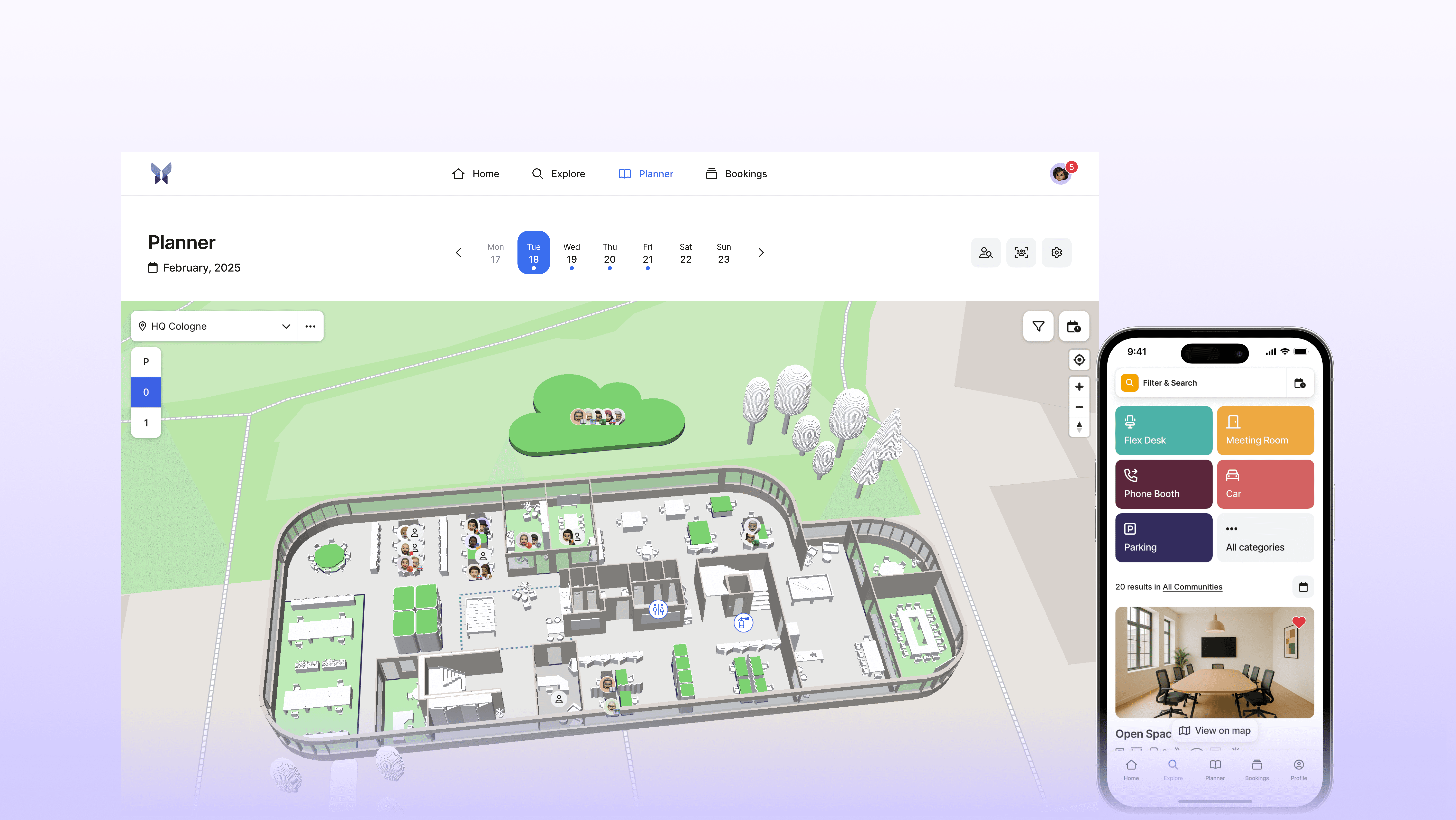
anny is a SaaS platform that helps companies make all types of resources in the office flexibly bookable. From desk reservations to parking bookings – everything operates through a central system.
Specific Use Cases
Desk Booking: Employees reserve their workspace in advance for Tuesday and Wednesday and know exactly where to sit.
Team Zones: Project teams book shared areas for sprints or workshops.
Executive Overview: Managers can see at a glance when their team is on-site – ideal for planning meetings.
Features for Hybrid Work Realities
anny offers features specifically tailored to a situation where hardly anyone comes to the office:
Communities for Teams: Defined groups can have shared booking rules.
Preferred Team Days: The system can prioritize certain days for specific teams.
Waitlists: On high-demand days, employees are notified as soon as a spot becomes available.
3D Floor Plans for Better Decisions
With visual floor plans, employees can see exactly:
Where available workstations are located
Which meeting rooms are available
Where creative spaces or quiet zones are situated
Whether colleagues from their own team have already booked
This transparency makes it easier to make informed decisions: Is it worth coming to the office today?
Integration and Security
Important for HR and IT:
Calendar Integration: Outlook, Google Calendar, and others
HRIS Connection: Automatic synchronization with HR systems
Smart Lock Integration: Access to booked rooms
Hosting in Germany: GDPR and ISO-27001 compliant
Additional Bookable Resources
Besides desks, with anny you can also book:
Meeting and conference rooms
Parking spots and charging stations
Equipment such as laptops or workshop materials
Visitor slots for external audiences
Internal training sessions and events
Those who want to gradually convert their office to desk sharing and hybrid models can either start for free for 14 days or schedule a demo.
FAQ: Frequently Asked Questions When Hardly Anyone Comes to the Office Anymore
How many office days per week are ideal for hybrid teams?
There is no one-size-fits-all solution, but models with 2-3 office days and 2-3 home office days work well in practice. It is advisable to decide on a team basis: at least one common day for everyone, another for project-related work, and the remaining days flexibly. This arrangement should be reviewed annually to accommodate changes in team sizes, projects, and employee needs.
At what team size does a desk-sharing and booking system make sense?
Structured booking is often worthwhile from as few as 30-50 people in a space, especially with multiple teams and varying attendance. anny can be used by both small companies with one location and corporations with multiple sites. Just a few overbooked or chaotic days highlight the benefits of a system - transparency and planning significantly reduce frustration.
How do I handle employees who do not want to come to the office at all?
Conduct personal interviews to understand individual reasons - commuting time, caregiving responsibilities, or health aspects often play a role. Define clear, fair minimum presence rules, but at the same time create real added value on-site through team days, good equipment, and meeting spaces. In exceptional cases, individual solutions (almost entirely remote with occasional presence appointments) can be agreed upon if the role permits.
How can I objectively measure the occupancy of our spaces?
Occupancy can be determined from booking data from tools like anny, access control systems, or simple manual counts on typical days. Collect data over several weeks or months to smooth out seasonal effects and outliers. This data then serves as the basis for space reduction, zone repurposing, or adjustment of the desk-sharing model.
How long does it take to implement a desk-sharing model with a booking system?
Small to medium-sized companies can go from decision to go-live in about 4-8 weeks with good preparation. Large organizations with multiple locations often need several months, mainly due to coordination with workers' councils, IT security, and data protection. anny can be implemented gradually - for example, with pilot days or individual sites - to gather experience and accelerate the roll-out.