

Amira van Weegen
Junior Marketing Manager
September 8, 2025
Open Workspaces: The Modern Workplace for Collaborative Teams
4 min

The New Way to Collaborate
The world of work has changed significantly in recent years. While traditional offices with workstations and closed single offices were the standard for decades, today open workspaces are the new norm. These open work environments promise more collaboration, flexibility, and cost efficiency - but they also bring new challenges.
What are Open Workspaces?
An open workspace refers to an office environment without fixed partitions, where employees work in a large, contiguous area. Unlike the traditional open-plan offices of the 1970s, modern open space offices are thoughtfully designed and divided into different zones.
The transition from traditional individual offices to flexible work environments began as early as the 1990s, but it wasn't until the 2010s that companies like Google and Facebook achieved a breakthrough. These firms recognized that physical barriers also create communication barriers and embraced open structures to foster innovation.
Differences Between Various Office Concepts
Concept | Characteristics | Application |
|---|---|---|
Open-Plan Office | Rows of desks without zoning | Traditional Administration |
Open Space Office | Open area with basic zoning | Startups, Creative Industries |
Modern Open Workspace | Activity-based areas with flexible setups | Tech Companies, Consultancies |
The integration of various work zones is essential for the success of modern open workspaces. Instead of a uniform office space, areas for teamwork, focused individual work, meetings, and relaxation are created.
Benefits of Open Workspaces
The benefits of open workspaces extend far beyond mere cost savings. These include:
Spontaneous interactions: Brief discussions between colleagues occur naturally without the need to schedule meetings
Cross-departmental collaboration: Teams from different areas can accelerate collaborative projects more swiftly
Reduction of hierarchical structures: Executives work on the same level as their employees
Increased transparency: The flow of information is improved due to the proximity of workspaces
Companies report significantly faster decision-making processes as communication paths are shortened. Instead of emails or phone calls, colleagues can exchange ideas directly and develop them.
The flexibility in restructuring is another key advantage. Growing teams can quickly receive additional workspaces without requiring extensive renovation efforts. This adaptability supports agile working methods and enables companies to respond swiftly to market changes.
Challenges and Drawbacks of Open Workspaces
Despite all the advantages, open workspaces also bring challenges that companies must take seriously. The most common complaint from employees concerns noise disturbance from conversations, phone calls, and office equipment like printers.
Other issues:
Lack of privacy: The constant feeling of being watched can lead to stress
Temperature and climate conflicts: Different preferences in heating and air conditioning
Difficulties with confidential conversations: Sensitive topics cannot be discussed openly
Particularly introverted employees may suffer from social exposure. They need retreat spaces to recharge their energy and work productively.
The challenge for companies is to harness the benefits of open communication without exacerbating the drawbacks. Therefore, thoughtful design is critical for the success of open workspace concepts.
Successful Design of Open Workspaces
Successfully implementing an Open Workspace requires far more than just knocking down walls. The key is a thoughtful design that supports both collaboration and focused work. Three factors are particularly important: zoning, acoustics, and equipment.
1. Zoning and Layout
A clear division provides structure and accommodates different working styles:
Collaboration Zones: Open areas with flexible furniture for team and project work
Focus Areas: Quiet spaces for concentrated individual work
Meeting Rooms: Enclosed spaces for confidential conversations or workshops
Break Areas: Relaxation zones away from workstations
Phone Booths: Soundproof rooms for uninterrupted phone calls or video calls
2. Acoustics as a Success Factor
Acoustics are crucial for the acceptance of open workspaces. Without effective measures, noise levels quickly become overwhelming. Helpful solutions include:
Acoustic Panels on ceilings and walls to reduce echo effects
Carpets and Textiles that absorb sound and create a pleasant atmosphere
Green Plants as natural sound dampeners and to improve the room climate
3. Ergonomics and Technical Equipment
Health and productivity go hand in hand. Therefore, height-adjustable desks, ergonomic chairs, and well-equipped workstations should be standard. Additionally, stable Wi-Fi, sufficient power outlets, and mobile devices ensure employees can work flexibly and efficiently anywhere.
4. Retreats and Quiet Zones
Lastly, a good open workspace also needs quiet zones. These are essential for concentrated tasks or introverted employees who need solitude at times. These retreats should be deliberately marked and respected to fulfill their purpose effectively.
How anny optimises your Open Workspace Management
Managing open workspaces is significantly simplified by modern desk sharing software. This is exactly where anny comes in, offering a comprehensive solution for the challenges of flexible work environments.
Smart Workplace Reservation
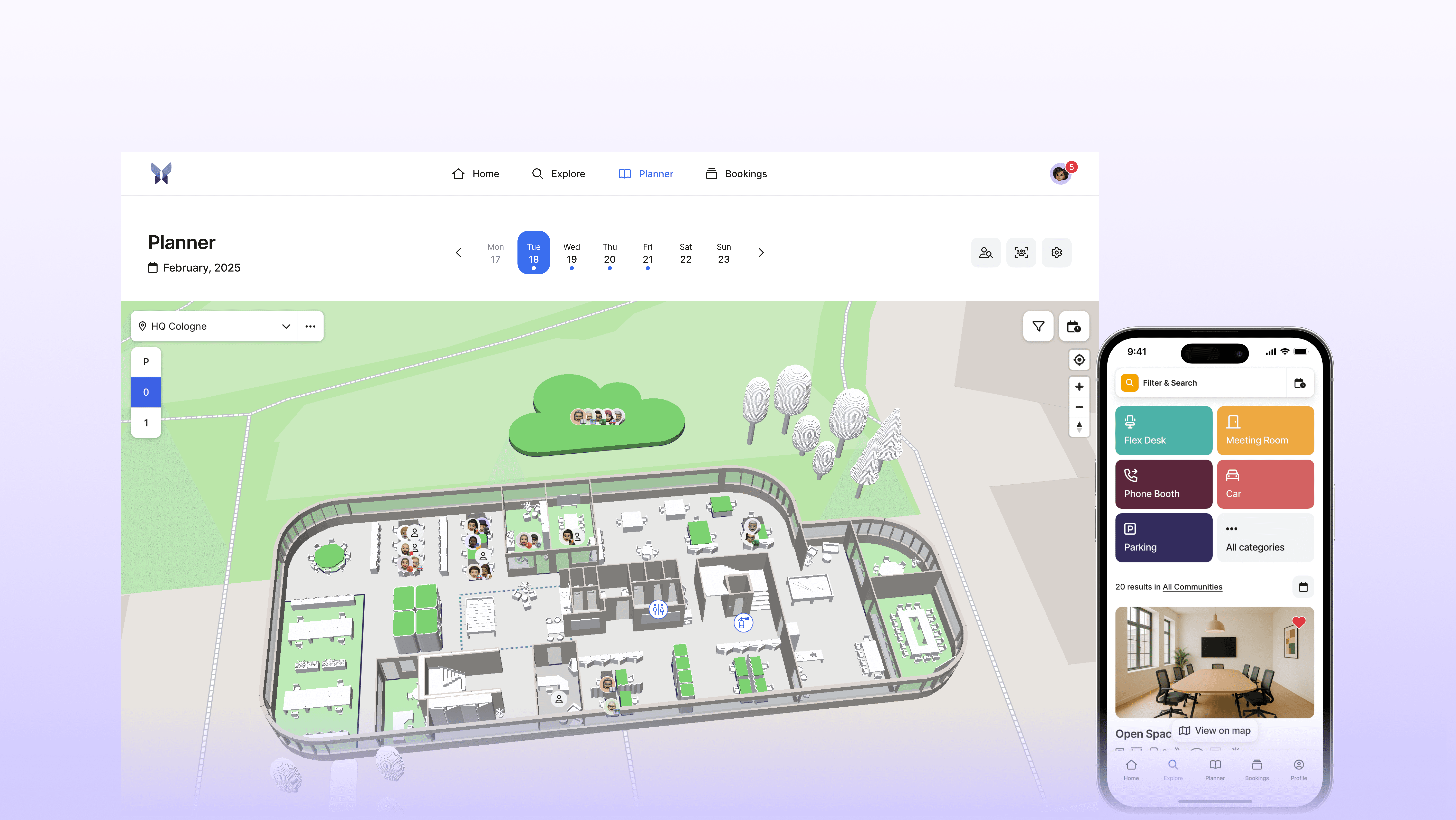
anny's desk sharing software enables employees to flexibly reserve workspaces in the open workspace. With 3D maps, users receive an intuitive visualization of available workspaces and areas.
Core Features for Open Workspace Management:
Weekly Planner for Hybrid Work: Book the entire week with just 5 clicks
Community Features: Manage access rights to different areas
Seamless Integration: Connect with MS Teams and Outlook for easy booking processes
Mobile App: Spontaneous workplace search and booking
GDPR-Compliant Data Processing: Secure workspace management
Analytics and Optimization
anny's analytics features additionally offer valuable insights into the use of open workspaces. It's possible to identify which areas are highly frequented and where there is a need for optimization.
By capturing usage patterns, workplaces can be planned more efficiently, enhancing employee satisfaction. Data analysis also aids decisions on future space concepts and investments in office equipment.
The combination of intelligent workspace management and thoughtful space design makes the difference between successful and failed open workspace projects.
Conclusion
Open workspaces are more than just a trend - they are a response to the changing demands of the modern working world. However, success largely depends on thoughtful design and the use of appropriate management tools. Companies that both leverage the benefits and proactively address the challenges create work environments that promote productivity, satisfaction, and innovation.
With the right combination of workspace design, technical equipment, and intelligent management through desk-sharing solutions like anny, open workspaces can reach their full potential and become a true competitive advantage.
Schedule a free consultation now to implement your open workspace project.





" height="38px" id="bH388uk2E" transform="translate(1 1)" width="118.00000395534607px"/></svg>)