
February 20, 2026
Space Shortage in the Office: How to Solve the Problem in Your Meeting Rooms
6 mins

Key Insights
Lack of meeting room space is one of the most common sources of frustration in modern working life. The good news: The problem often lies not with having too little space, but with how rooms are used and managed.
Lack of room space is often an organizational issue, not a space issue – lack of transparency and unclear rules lead to inefficient use of available meeting rooms
Ghost bookings and no-shows block up to 30% of meeting rooms, even though they would actually be available
Hybrid work has fundamentally changed space requirements since 2020 – old room concepts no longer fit with fluctuating presence patterns
Digital room booking systems are a key lever to optimize occupancy, reduce stress, and make data-driven decisions
Even simple measures like check-in rules and booking policies can significantly reduce perceived room scarcity
Space constraints in the office – do you experience this too?
09:00 AM, Monday morning. Your team is standing in front of the conference room, which should be free according to the calendar. The door is closed, inside are colleagues from another department. The Outlook appointment? Was never entered. Or was it—by someone else. The confusion is complete, the meeting starts 15 minutes late in the coffee kitchen.
If you are an office manager, HR person, or team lead, you're probably all too familiar with such scenes. You juggle daily with room conflicts, spontaneous rebookings, and frustrated employees who just want a place for their meeting. Ad-hoc meetings? Hardly possible, because all rooms are marked as booked in the calendar, although many of them are actually empty.
The problem has significantly worsened since 2020. With hybrid work, changing office days, and growing teams, old office concepts just don't fit anymore. The good news: In this article, you'll find concrete, practical solutions—from simple booking rules to digital space planning that really works.
Causes of Space Shortage in the Office
Before you panic and start renting spaces or planning expensive renovations, it's worth taking a closer look at the actual causes. Often, perceived space shortages are not a question of space but rather an organizational issue.
The most common causes at a glance:
Cause | Typical Example |
|---|---|
Phantom Bookings/No-Shows | Weekly meeting has been on the calendar for months but doesn’t happen |
Oversized Bookings | 2 people regularly book the 12-person room 'just in case' |
Lack of Transparency | No one knows which rooms are actually available and when |
Hybrid Working | Extreme peaks on team days, empty rooms on other days |
Unclear Responsibilities | No one evaluates data on room usage or defines rules |
Phantom Bookings and No-Shows
Phantom bookings are reservations that appear on the calendar but are not utilized. The room is blocked but remains empty. A classic example: The weekly team update that was scheduled three months ago – but nobody deleted the recurring booking. The large meeting room is 'occupied' every Tuesday from 10 to 11 AM, even though it stands empty.
The problem: Without check-in mechanisms, there is no automatic release. Colleagues see 'occupied' in the system and seek other places – or completely reschedule their meetings. In companies with around 50-100 employees, such no-shows lead to a measurable decline in room utilization. Studies show that up to 30-50% of booked meeting rooms remain actually unused.
Overbooking and Wrong Room Choice
Out of uncertainty, many teams prefer to book 'too large.' When it's unclear if more attendees will join or when smaller rooms are hard to find, people opt for the largest available conference room.
Concrete example: The 3-person regular meeting blocks the only 10-12-person room every Tuesday morning – at prime time – for two hours. Other teams genuinely needing a large room for workshops or projects miss out.
This behavior is encouraged by the absence of booking rules. If the system doesn't specify that certain rooms can only be booked from a minimum number of people, everyone uses whatever is available. Additionally, unclear room categories – focus room vs. workshop room – contribute to misuse.
Lack of Transparency and Data
Many companies rely solely on Outlook or Google Calendar for room bookings. The problem: These tools show what is booked – but not what is actually used.
Imagine you are a facility manager tasked with planning room utilization for 2025. You need answers to questions like:
Which rooms are utilized on which weekdays?
What is our no-show rate?
Do we need more small focus rooms or more large workshop spaces?
Without a central platform with evaluations, you make such decisions 'by gut feeling.' This leads either to unnecessary investments in additional spaces – or to genuine bottlenecks going unnoticed.
Hybrid Work and New Usage Profiles
Since the introduction of hybrid models around 2020/2021, meeting patterns have fundamentally changed. Desk sharing and varying presence create completely new demands on room design.
A typical pattern: Teams are in the office only 2-3 fixed days per week. On these days, the demand for meetings spikes sharply. Tuesday becomes a 'battle day' for every free room, while Thursday and Friday rooms remain half-empty.
Traditional space planning – fixed workspaces, few large conference rooms – no longer meets this pattern. Without flexible room booking, the impression arises: 'There are never enough rooms.' In reality, it’s not a lack of space but the flexibility to adapt it to actual demand that is missing.
Effects of Space Shortage on Teams and Productivity
Lack of space is not just a comfort issue. It directly affects productivity, collaboration, and company culture.
The specific impacts on daily work:
Frustration and tension: Teams get annoyed when meetings start late or have to be relocated frequently
Time loss: 5-10 minutes spent searching for a room per meeting adds up to noticeable productivity losses
Poor meeting culture: Spontaneous meetings happen less often because "there's never a room available," causing delays in decision-making
Disparate treatment: Certain teams or hierarchical levels "always reserve the best rooms," which is perceived as unfair
Poor space management: Companies rent additional spaces even though existing rooms are used inefficiently
Concrete examples from office life
The effects are evident in typical scenarios you might be familiar with:
Scenario 1: The project team urgently needs a room for a 2-hour workshop. All meeting rooms are booked according to the calendar. The workshop ends up taking place in the coffee kitchen—with corresponding acoustics and disturbances.
Scenario 2: An important candidate interview is scheduled. The reserved meeting room is unexpectedly occupied. The candidate waits in the lobby while you frantically search for an alternative. Not a great first impression.
Calculation example: At 50 meetings a day, with only a 5-minute delay, over 4 hours of productive company time is lost daily. Calculated over a month, this amounts to more than 80 working hours—time that is missing for projects, communication, and exchanges.
These recurring issues also affect the perception of office and facility management. Employees feel: "The office isn't working." Efficiency suffers, and the role of workspace management is underestimated.
General Solutions for Space Shortage
Not all solutions require immediate budget for renovations or software. Some improvements can be made with clear rules and more transparency.
The most important levers can be grouped into four areas:
Define clear booking rules
Regularly analyze room occupancy
Introduce flexible room concepts
Integrate hybrid work models into room planning
The mix of organizational and technical measures is most effective. In the next section, we will take a look at how digital tools can enhance these measures.
Define clear booking rules
A good start: Develop simple, understandable company-wide guidelines for room bookings. One to two A4 pages on the intranet are perfectly sufficient.
Examples of sensible rules:
Rule | Purpose |
|---|---|
Appropriate room size for the number of people | Prevents 2-person groups from occupying a 12-person room |
Maximum lead time for bookings | e.g. max. 2 weeks in advance for recurring appointments |
Maximum duration during peak times | e.g. max. 60 minutes between 10-3 PM |
No-show rule | Automatic or manual cancellation after 10-15 minutes |
Last minute window | Rooms without confirmation 15 minutes before start can be taken |
Such rules create fairness and help distribute existing resources better. Studies show that clear booking rules can increase occupancy by 20-40%.
Regularly analyze room occupancy
At least once per quarter, you should evaluate room usage. Even with simple means – like an Excel spreadsheet based on calendar data – important insights can be gained.
Relevant metrics:
Average occupancy per room
No-show rate (booked vs. actually used rooms)
Occupancy by weekday and time
Ratio of small vs. large rooms
Based on this data, you can make informed decisions: Do we need more small focus rooms? Should we divide a large room? Is additional space really necessary – or is better utilization sufficient?
These figures are also invaluable when it comes to budget and space decisions. Instead of arguing based on 'gut feeling,' you have reliable facts for management.
Flexible room concepts and multipurpose rooms
Where structurally possible, it is worthwhile to complement rigid large conference rooms with flexible furnishings. Mobile partition walls, foldable tables on wheels, and modular seating with armchairs allow a room to be adjusted as needed.
Practical tips:
Versatile rooms with flexible tables that can be used from 2-person meetings to 12-person workshops
Additional small meeting zones: focus boxes, phone booths, or 2-person rooms for short meetings
Designate informal areas (lounge, coffee corner) consciously as meeting zones and equip them with the necessary technology
These room-in-room systems offer flexibility without requiring major renovations. The equipment with conference tables of varying sizes and modular design helps meet diverse requirements.
Integrate hybrid work models into room planning
If your company practices hybrid work, you should consciously incorporate attendance days into room planning.
Concrete measures:
Coordinate office attendance days (e.g. team days Tuesday/Thursday) with meeting room planning
Create meeting guidelines: When is remote, when hybrid, when in-person?
Establish virtual meetings as a real alternative – not every meeting needs a physical room
Consciously manage home office days and team office days using occupancy data to flatten peaks
This coordination between work model and room concept can significantly reduce the pressure on meeting rooms.
Digital Space Planning as a Game Changer
Starting at around 30-50 employees, Excel lists and basic calendar management quickly reach their limits. At the latest, when multiple locations, floors, or room types need to be managed, scheduling becomes confusing and chaotic.
A modern room booking software does so much more than a standard calendar:
Centralized real-time overview of all rooms and their availability
Automated booking rules (room size, maximum duration, user permissions)
Smart check-in features to eliminate ghost bookings
Insightful analytics and dashboards for data-driven workspace decisions
Seamless integration with existing tools (Outlook, Google Calendar, MS Teams)
Digital scheduling supports your organizational guidelines and makes them truly scalable. Instead of enforcing rules manually, the system takes care of it for you!
How digital room booking eliminates room shortages
The biggest benefit: employees can see exactly which rooms are free right now or in the next few hours on a central dashboard or interactive office map. No more guessing games.
Key features and their benefits:
Feature | Impact |
|---|---|
Real-time availability | Instant overview of available spaces |
Mandatory check-in | Unused bookings are automatically released |
In-system booking rules | The perfect room size is automatically suggested or required |
Recurring events | Recurring bookings with automated confirmation reminders |
Ad-hoc bookings | Spontaneous meetings made easy – instantly view and book open slots |
With smart check-in features – via QR code or app – ghost bookings are drastically reduced. If no one checks in within 10 minutes, the room is automatically released back to the team. Studies show a fantastic 40-60% reduction in no-shows!
anny as the prime example of intelligent room booking
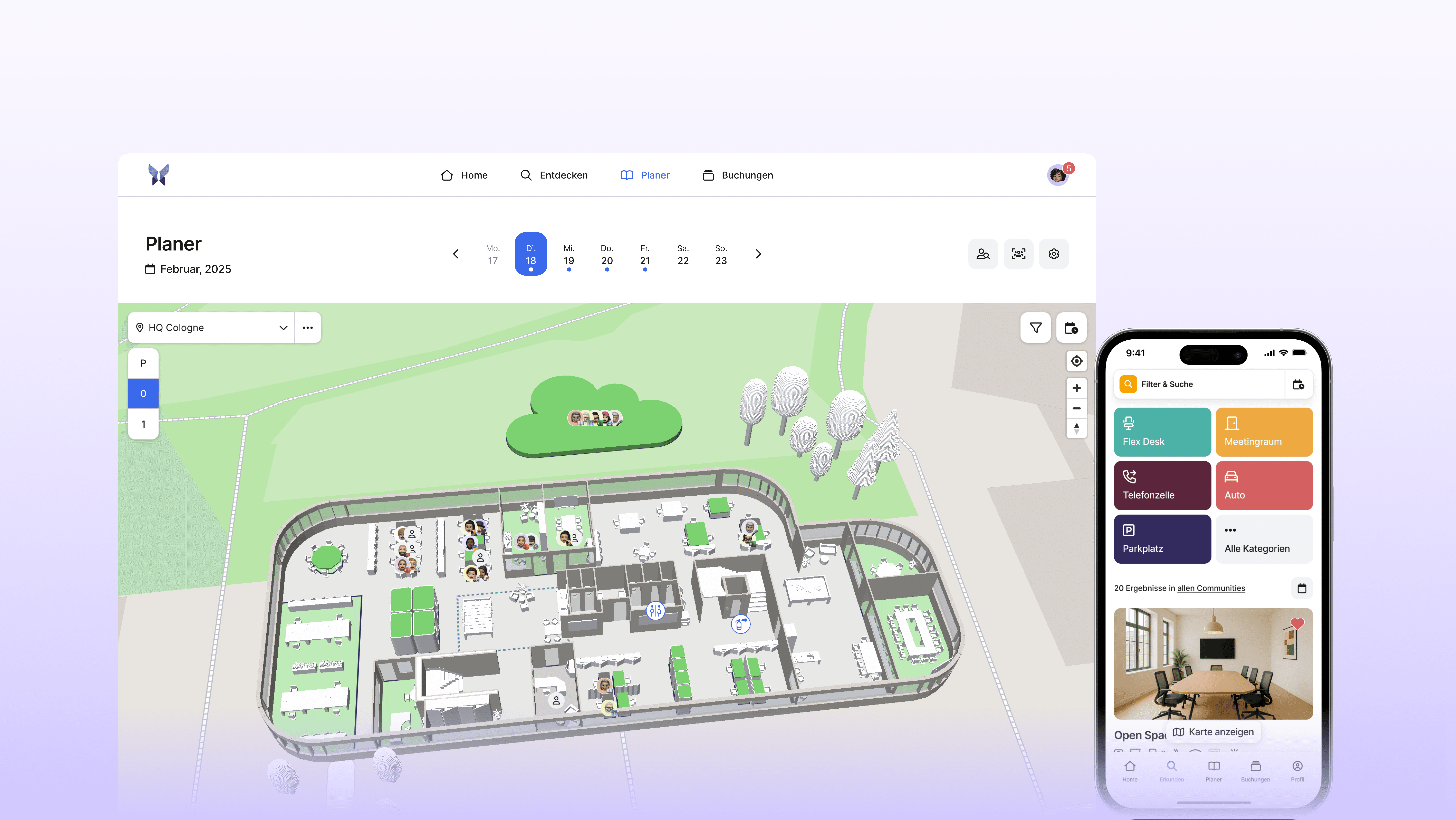
anny is a SaaS platform hosted in Germany, specifically designed for booking workstations, meeting rooms, parking spaces, and many other resources.
What makes anny stand out:
Interactive 3D maps: Employees can select their room visually – for example, close to their team or with specific equipment
Automated releases and check-ins: Reduce no-shows significantly as unused bookings are automatically cancelled
Room utilization analytics: Dashboards display occupancy by location, floor, and room type – the perfect foundation for efficient space planning
Digital signage: With the room display app, you can view real-time room availability directly on-site and book ad-hoc meetings with just a single tap
Seamless integrations: Outlook, Google Calendar, MS Teams, and other interfaces make it incredibly easy for employees to get started
GDPR-compliant and hosted in Germany: Crucial for enterprises with high data privacy and security requirements
The best part: anny is fully modular. You can start with meeting rooms and later add desks, parking spots, or even visitor management – all in one single, friendly platform.
Success stories: How companies can tackle room shortages with anny
Example: A fast-growing tech company
Imagine a tech company with 150 employees that previously organized its meeting rooms via Outlook. The typical result: constant double-bookings, frustrated teams, and the feeling of "never being able to find a room."
With anny, that's easy to change! Through mandatory check-ins, clear booking rules, and an interactive 3D map, the number of perceived room bottlenecks could drop significantly within just a few months. The utilization data would be particularly valuable – showing, for instance, that a large 20-person meeting room is rarely used for more than 8 people. This allows the company to split it into two smaller rooms, solving their biggest bottleneck in no time!
Conclusion: From Perceived Space Shortage to Smart Office Planning
A lack of space in the office is often a symptom of a lack of rules, insufficient transparency, and inadequate data – not necessarily a lack of actual space. Before you invest in additional square footage, it's worth taking a closer look at your actual space utilization.
The key levers at a glance:
Define and communicate clear booking rules
Regularly analyze space utilization and make data-driven decisions
Introduce flexible space concepts that complement hybrid work models
Use digital room booking systems to automatically enforce rules and create transparency
You don't have to implement everything at once. Start with a small step – like a no-show policy or an initial data analysis. The results will speak for themselves!
If you want to see how anny can simplify your space planning, take a look at the platform. You can get started for free or book a demo and find out in just a few minutes if it fits your needs.
Structured space planning doesn't just reduce daily stress. It also helps you use your office space more efficiently and cost-effectively in the long run – a goal that every company will get behind. For an overview of different room booking systems, check out our comparison article.
Frequently Asked Questions (FAQ) About Office Space Shortage
How can I determine if we really have too few rooms or are just misusing them?
Collect simple data over 4-6 weeks: number of meetings per day, booked vs. actually used rooms, no-shows, and peak times. Even a short observation period will reveal if large rooms are regularly occupied by small groups or if certain days are extremely overloaded.
A room booking software like anny can automatically capture this data and evaluate it in dashboards. This gives you a clear overview without having to manually keep logs.
What can I do immediately if all rooms are constantly booked?
Three quick actions you can start today:
Implement a no-show policy: Rooms that are not used within 10-15 minutes are released again
Review recurring appointments: All recurring bookings must be confirmed or deleted by the responsible parties
Communicate fair-use policy: Large rooms (8+ people) only for accordingly large groups; shift small meetings to focus pods or small rooms
At what company size is professional room booking software worthwhile?
A specialized solution typically makes sense from around 30-50 employees or as soon as you manage multiple meeting rooms. From this size, conflicts, no-shows, and organizational effort increase significantly when only calendars are used.
Tools like anny are modularly structured. You can start small and later add other resources like workspaces or parking spaces.
How can I convince my management to invest in space planning?
Prepare concrete numbers: time lost searching for rooms, no-show rate, potentially saved space costs. A brief evaluation or a pilot phase with a booking tool provides reliable data.
The investment often pays off quickly through more efficient use of existing spaces and fewer room conflicts. Start with a small pilot area—such as one floor—and present the results to management.
How do I deal with team resistance to new booking rules or tools?
Involve those affected early and make the benefits for their everyday life visible: less searching, clearer rules, less frustration. Offer short training sessions or info sessions and identify "power users" who can serve as contacts within the team.
An intuitive solution like anny significantly lowers the entry barrier. Employees can book rooms directly in the browser or through familiar tools like MS Teams—without major changes.