

Amira van Weegen
Marketing Manager
January 15, 2026
7 Benefits of a Workspace Booking System 2026
7 min

Introduction
The world of work is changing rapidly. In 2026, companies face many challenges. Hybrid work models and flexible team structures require solutions that offer transparency and adaptability. This is the only way to sustainably increase productivity and employee satisfaction.
A workspace booking system becomes the key to reducing costs and optimally managing office utilization.
In this article, you'll discover the 7 key benefits such a system brings to your company and how it sustainably improves everyday work.
What is a workspace booking system?
A workspace booking system is a digital solution that allows companies to efficiently manage and reserve workspaces. It provides employees the ability to book a desk, room, or even equipment in advance or on a whim. Especially in times of flexible and hybrid work models, the workspace booking system becomes the heart of modern office organization.
Traditional vs. Modern Workspace Booking Systems
In the past, many companies relied on analog methods like Excel lists or paper plans. However, these were prone to errors and offered little flexibility. Modern, cloud-based workspace booking systems, on the other hand, provide a real-time overview of all available spaces and can be accessed from anywhere via app or browser.
Criteria | Traditional (Excel, Paper) | Modern (Software) |
|---|---|---|
Timeliness | Manual, often outdated | Real-time, always current |
Flexibility | Limited | High, location-independent |
Scalability | Low | Very high |
Error-proneness | High | Low due to automation |
Integration and Core Functions
A workspace booking system can now be seamlessly integrated into existing company systems. Typical interfaces include calendar tools, access control, or SSO integrations. This ensures automated processes and less administrative effort.
The core functions include:
Real-time overview of available and occupied spaces
Mobile booking and cancellation
User management and role concepts
Filters by location, equipment, or team
Automated reminders and check-in
Challenges Without a Booking System
If companies forego a workspace booking system, they often encounter the following problems:
Inefficient use of office space
Frequent double bookings and uncertainty in workspace selection
High organizational effort for administration and coordination
Employee dissatisfaction due to lack of planning capability
According to current statistics, by 2025, over 60% of companies globally will rely on hybrid workspace models, a trend that is hardly manageable without digital support.
The 7 Benefits of a Workplace Booking System 2026
The world of work is undergoing a transformation in 2025, which companies must actively shape. A workspace booking system becomes the heart of modern office concepts. It enables flexible, efficient, and data-driven use of office spaces. Below, we present the seven key advantages of such a system and show how it sustainably improves everyday work.
1. Flexible Workspace Utilization and Desk Sharing
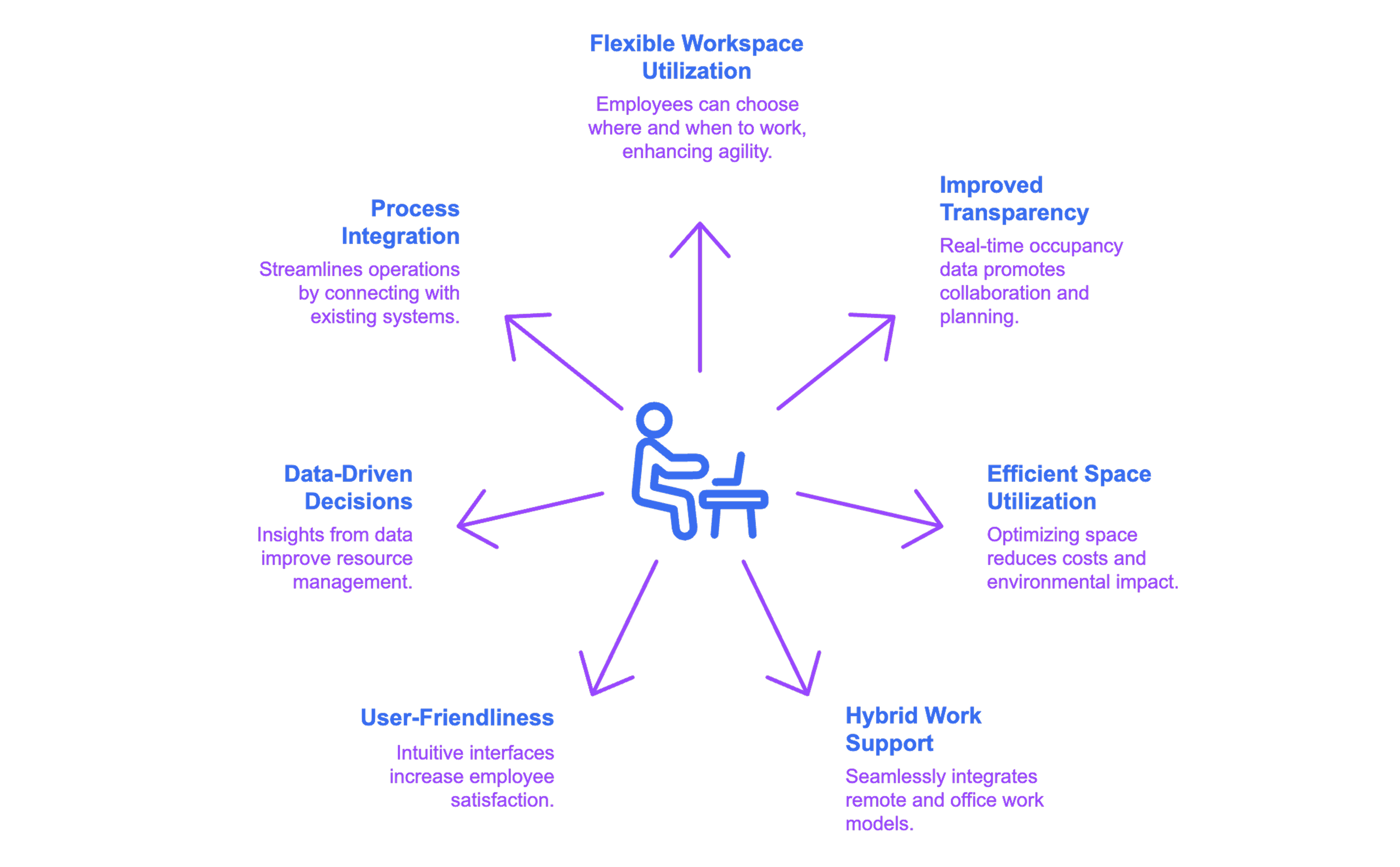
A workspace booking system revolutionizes the way employees select their workstations. Whether home office, mobile work, or fixed desks, the system allows for maximum flexibility. Employees decide for themselves when and where they want to work.
Companies benefit from optimal utilization of office spaces. Desk sharing becomes standard: teams can collaborate on projects or define individual home zones for special requirements. This creates dynamic work environments that adapt to actual needs.
A recent study shows: 75% of companies using a workspace booking system report significantly higher space efficiency. This flexibility allows for optimal use of resources while also increasing employee satisfaction.
In short, desk sharing and flexible bookings are key to a modern, agile work culture. Companies can manage with fewer fixed desks and plan their spaces more effectively.
2. Improved Transparency and Planning Security
A workspace booking system offers a real-time overview of workspace occupancy and availability. Employees and teams immediately know which spaces are free and who is in the office and when. This facilitates planning and promotes collaboration.
By integrating calendar functions, bookings can be made for individual days or as recurring bookings. This allows teams to plan regular meetings or project days in advance. The clarity ensures that double bookings and misunderstandings are avoided.
Pfizer, for example, uses live plans to manage weekly team coordination. With filter functions, users can search specifically for equipment, location, or certain colleagues. This increases transparency and makes workspace selection more efficient.
Planning certainty is crucial not only for individual employees but also for managers and HR departments. They get a clear overview of attendance and can manage resources specifically. A workspace booking system makes everyday work more predictable and reduces organizational effort.
The result: higher satisfaction, better team spirit, and a structured work environment. Transparency creates trust and sustainably supports flexible work organization.
3. Efficient Space Utilization and Cost Savings
A workspace booking system provides detailed occupancy statistics that enable targeted optimization of office spaces. Companies can quickly identify which areas are underused and potentially shut down or redesign them.
The reduction of operating costs is a central advantage. Less used areas mean lower expenses for rent, energy, and cleaning. With the flexible adaptation of workspaces to company growth or downsizing, investment remains future-proof.
Visualized office plans in the workspace booking system simplify management and enable sustainable space planning. Companies report savings of up to 20% of office space thanks to targeted optimization.
With a workspace booking system, not only are costs reduced, but also the environment is relieved, and the work environment is made more attractive.
4. Supporting Hybrid Work Models
The world of work in 2025 is hybrid. A workspace booking system digitally represents flexible, fixed, and mobile workspaces. Employees can easily plan and combine home office days and office times.
The system promotes new work concepts and supports employee autonomy. By integrating all work models into a single interface, management becomes significantly simplified. Managers and HR always have an overview of attendance and occupancy.
Companies can establish individual booking guidelines. For example, exclusive areas can be defined for specific teams or sensitive departments. This ensures both flexibility and structure.
For many employees, the ability to flexibly switch between home office and office is a crucial motivating factor. A workspace booking system makes hybrid working practical and future-proof.
5. User-Friendliness and Employee Satisfaction
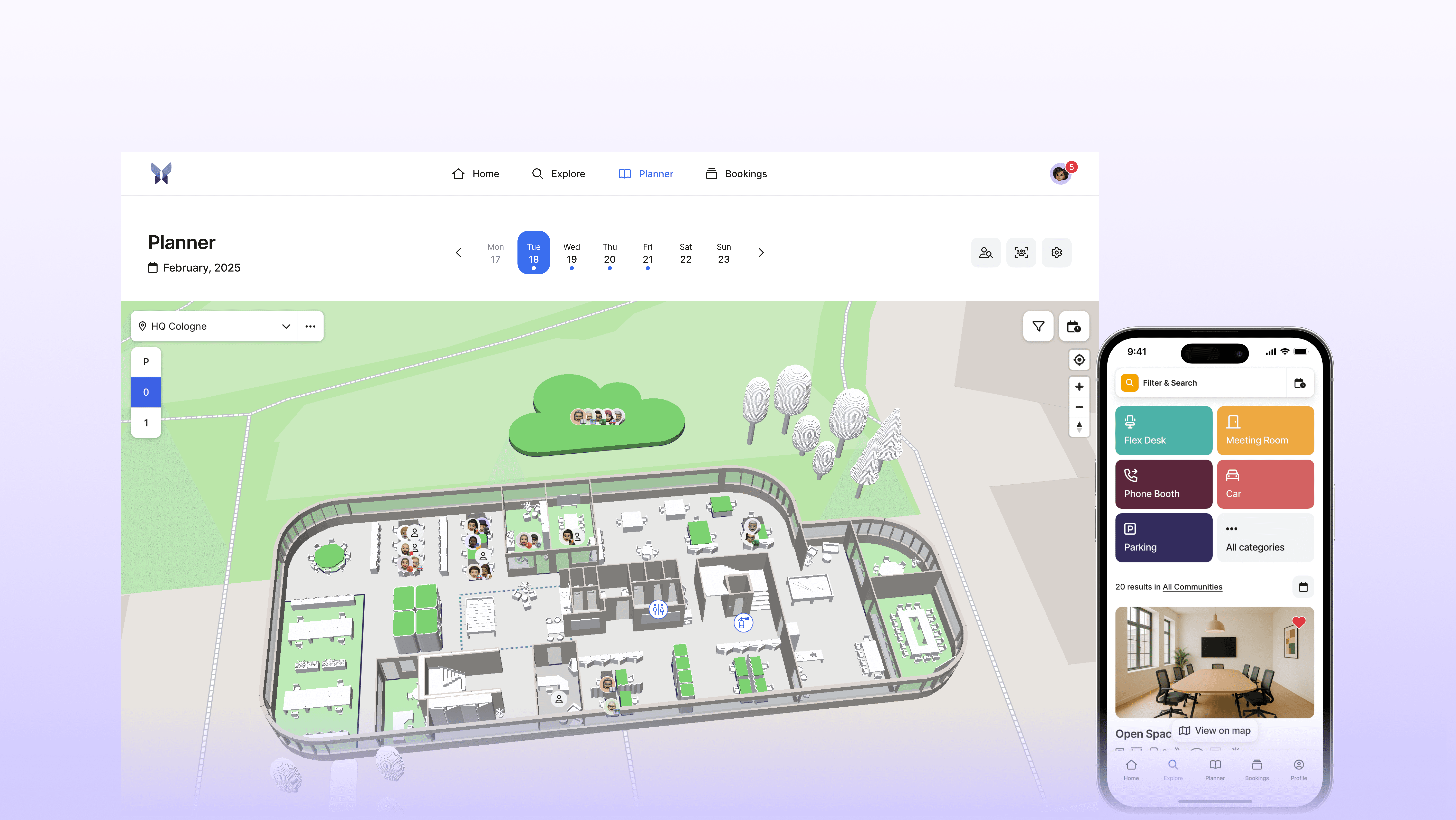
A workspace booking system impresses with its intuitive operation, both in the web browser and via mobile app. Interactive office plans make orientation easy, whether in open-plan offices or flexible work zones.
Users can set favorites and use filters to specifically search for certain workspaces, colleagues, or facilities. Quick booking and uncomplicated cancellation ensure maximum flexibility in everyday work.
A workspace booking system increases motivation because employees can choose their workspace themselves. This promotes personal responsibility and increases identification with the company.
The digital solution reduces frustration and creates a pleasant, transparent work atmosphere. User-friendliness is thus a central building block for the successful implementation of a workspace booking system.
6. Data-Driven Decisions and Smart Office Statistics
With a workspace booking system, companies have access to a wealth of real-time data. Analyzing booking and occupancy data allows trends and usage patterns to be identified. Reports for HR, management, and controlling provide clear decision-making bases. Data privacy-compliant collection and evaluation are, of course, ensured.
An example from practice: Companies use data from the workspace booking system to create forecasts for future space requirements. This allows for better planning of investments and efficient use of resources.
Data-driven management ensures sustainable improvements and increases competitiveness. A workspace booking system makes the office smart, flexible, and adaptable.
7. Integration and Automation of Processes
A workspace booking system can be seamlessly integrated into existing company systems. This includes calendars, access control, or HR software. The automatic synchronization of bookings and resources significantly reduces manual effort.
User groups and access rights can be easily managed. Recurring bookings and automated check-ins save time and ensure smooth operations. API interfaces allow the system to be individually expanded.
Automated notifications and reminders support everyday work. The scalability of the workspace booking system is ideal for growing or distributed organizations.
Integration ensures that all processes are interlinked. This makes management more efficient, minimizes errors, and improves user experience.
A workspace booking system is more than just a booking platform - it's the engine for digital transformation in office management.
Best Practices for Implementing a Workspace Booking System
The successful implementation of a workspace booking system is no coincidence; it is the result of targeted planning and structured execution. Companies that follow best practices benefit from smooth operations and high team acceptance.
1. Needs Analysis & Company Structure
At the beginning stands a precise analysis: How many workspaces are needed? Which teams work hybrid, mobile, or fixed? The selection of the appropriate workspace booking system should be tailored to individual processes.
2. Actively Involve Employees
Employees should be involved early in the selection process. Workshops, surveys, or pilot phases help address wishes and concerns. This creates a strong identification with the new workspace booking system and increases acceptance.
3. Communication & Training
Open communication is crucial. Explain why the workspace booking system is being introduced and how it facilitates daily work. Trainings - digital or on-site - ensure all functions are understood and uncertainties are cleared.
4. Clear Rules & Continuous Success Control
Define transparent booking rules and responsibilities. Who is allowed to book when? Are there home zones or exclusive areas? Continuous evaluation of usage data shows if the workspace booking system is running optimally. This allows for quick implementation of adjustments.
5. Practical Examples & Challenges
Experience shows: A step-by-step introduction, accompanied by support and feedback, leads to success. Typical challenges include data migration, technical interfaces, or overcoming reservations. With clear processes and open dialogue, these hurdles can be overcome.
Best Practice Steps at a Glance
Step | Goal | Tip |
|---|---|---|
Analyze Needs | Select the right solution | Involve stakeholders early |
Involve Employees | Ensure acceptance | Use pilot projects |
Communication | Promote understanding and motivation | FAQ & regular updates |
Training | Build skills | Provide short tutorials |
Success Control | Identify optimization potentials | Evaluate data regularly |
A structured introduction makes the workspace booking system a key factor for modern working.
Key Features of Modern Workspace Booking Systems 2026
A modern workplace booking system offers much more than just simple desk reservations. These systems combine intuitive usability with powerful features, making them the cornerstone of flexible and hybrid work environments. They help companies manage workplaces dynamically, transparently, and efficiently.
Visual Orientation and Interactive Office Plans
One of the most important features of a workplace booking system is the provision of interactive office and floor plans. These plans provide users with a clear overview of available and occupied workspaces in real-time.
Workspaces, meeting rooms, and home office options are clearly presented.
Users can specifically search by location, equipment, or proximity to colleagues.
The visual navigation especially assists new employees or guests in finding their way around the building.
This makes searching for a workplace not only easier but also more transparent and efficient.
Maximum Flexibility and Mobile Usage
Today, a workplace booking system must be available everywhere and at any time. Therefore, modern systems offer both web access and a mobile app.
Workspaces can be booked on the go or spontaneously at the office.
Automated check-in/check-out options ensure smooth use.
Favorites and filter functions simplify personal workplace selection.
With these tools, booking remains flexible even if plans change at short notice. Real-time availability overview prevents double bookings and enhances team satisfaction.
Integration, Automation, and Interfaces
The integration into existing corporate systems is a significant advantage of a workplace booking system. Particularly in demand is the connection to calendar software, access control, and HR tools.
Bookings are automatically synchronized with appointments.
API interfaces allow for individual extensions.
Automated notifications and reminders support organization.
As the integration of calendar systems shows, booking systems can be seamlessly integrated into the workday. This streamlines processes and significantly eases management.
User Roles, Security, and Modern Office Concepts
A workplace booking system offers differentiated role concepts and access rights for teams, departments, or external guests. This way, companies retain control over spaces and resources.
Rights and roles can be individually adjusted.
Bookings for home office days, parking spaces, or meeting rooms are centrally managed.
Security standards and data protection are consistently maintained.
These functions are central to efficiently designing new work environments and modern office concepts while providing employees with a safe, flexible environment.
You can see how a modern workplace booking system not only ensures more flexibility and planning but also increases team satisfaction while simultaneously reducing costs. Especially in the hybrid work world of 2025, it will be crucial to manage workplaces smartly, transparently, and user-friendly.
With anny, you can achieve exactly that: Optimize resource utilization, streamline processes, and offer your employees a modern work environment.
👉 Get started right away and test all features of anny easily and for free: Start for free now
👉 Or book yourself a free and non-binding demo with our sales team: Book a demo





" height="38px" id="bH388uk2E" transform="translate(1 1)" width="118.00000395534607px"/></svg>)