
July 20, 2026
Developing an AI Product: How We Turned the AI Hype into a Real Product at anny
8 min.

Introduction
AI is everywhere, but not every product delivers on the hype. What truly makes an AI product defensible and valuable is shown by the following insights gained from building anny AI:
According to an MIT study, 95% of AI projects yield no measurable impact — the issue is rarely the model itself, but rather the lack of integration into the product.
Simply building an AI wrapper around GPT offers no competitive moat — the decisive factor is which layer of the architecture we genuinely control (data, workflow, business logic).
Existing B2B SaaS products with clear use cases and robust customer data have a structural advantage over pure AI startups — provided they integrate AI deeply into their product development.
Context Engineering (MCP, custom context layer, live data) beats the model hype — that is how we at anny AI built an AI phone assistant that handles actual bookings instead of just sounding "smart".
Why the AI hype rarely leads to real product success
Between 2023 and 2026, billions have poured into Artificial Intelligence. Every other SaaS product launched an "AI feature." And yet, for most, a measurable business impact remains out of reach.
The statistics are sobering. A MIT study shows that around 95% of all generative AI initiatives in companies have no measurable effect on revenue or costs. In its Hype Cycle for Generative AI 2025, Gartner predicts that many generative AI projects will slide into the "Trough of Disillusionment." The reason? A mismatch between soaring expectations and real-world utility.
The issue is rarely the model itself. It lies in how AI is embedded into product development—or rather, how it isn't. AI is a powerful lever for smarter decision-making and streamlined processes, not an end in itself. Especially in complex SaaS workflows like resource booking, it's clear: without deep integration into existing systems, any AI feature remains purely cosmetic.
The AI Wrapper Dilemma: Why Some AI Products Lack Long-Term Defensibility
An "AI wrapper" is a product that, at its core, merely wraps a thin interface plus some business logic around an external language model API. The chatbot answers FAQs, summarizes texts, or generates images – but that's about it.
The problem: any other company can connect to the same API. Feature parity is achieved within weeks. No technical moat, no lock-in, no differentiation. The choice of technology stack is critical for developing an AI product, and "just OpenAI API" is not a stack. Integrating an AI model requires technology layers such as frontend, backend, and databases.
The comparison with Salesforce makes this clear: Salesforce deploys AI as an additional layer over an extremely rich CRM data model. What is defensible is the business logic, the permissions and roles model, and the deep integrations – not the underlying language model itself.
The core product question is: Which layer do we control ourselves?
Proprietary customer data (booking history, usage profiles)
Workflow engine and business rules
Integrations (calendars, HRIS, smart locks)
Permissions and roles model
A sustainable AI product combines its own strengths – existing data, domain expertise, user workflows – with language models, rather than just tacking on an "AI frontend". This insight from AI product development should feed into architecture design and the roadmap before the first AI features go live.
Two Strategies for AI Products in B2B SaaS – and Which One Wins
In the B2B SaaS market, we see two fundamentally different strategies for building AI applications.
Strategy A: New AI startups without a foundation. A focus on generic AI use cases, barely any proprietary customer data, often a pure AI wrapper around large language models. High pressure to find product-market fit quickly. The chances of success are slim if there is no in-house data or domain foundation.
Strategy B: Existing SaaS companies with a native AI layer. An existing user base, clearly defined workflows, and historical data. Established sales channels and market trends are already being served. A solid market analysis is often already done—target groups and the competitive landscape are well known.
At anny, we chose Strategy B. We built our AI layer on top of a stable foundation. For B2B SaaS founders, AI in product development means: embedding AI features along the existing customer journey (onboarding, search, booking, support)—no loose labs projects.
What really makes a great AI feature
Many AI features only deliver answers. An FAQ bot, a summary, a generated text. But a truly great AI function executes actions and changes the system state.
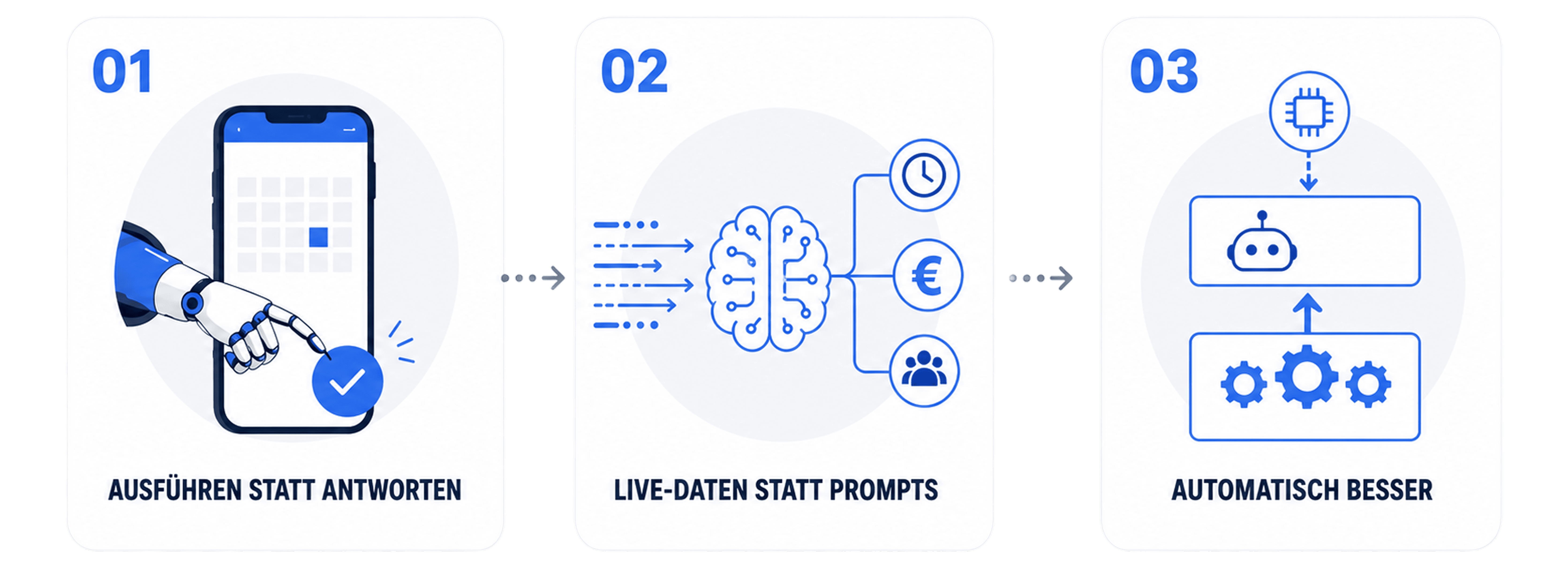
Three core criteria distinguish great AI features from mere gimmicks:
Execution over answers: The AI phone assistant in anny AI books a meeting room, reserves a parking spot, or completes a booking directly on the phone.
Live data over static prompts: Real-time availabilities, current pricing, company policies. anny AI checks team membership and booking windows in real-time, connecting external data sources to answer inquiries about rates or availability on the fly.
Automatically better with every model upgrade: The architecture separates agent logic from product logic. New models immediately deliver higher efficiency without requiring a complete rebuild of the business logic.
In a B2B context, great AI features always require governance: limits, escalation paths, and monitoring. The handoff between humans and AI must be seamless – with clear status indicators and logging for admins to easily understand AI decisions. Automation through AI is a fantastic way to elevate user experience and boost customer service!
anny AI Case Study: Why Customers Keep Calling Despite an Online Booking System
Online booking is supposed to take the pressure off your phones. Instead, customers often keep calling anyway – out of habit, for convenience, because they want advice first, or to clear up quick questions. Especially in sectors like sports classes or other consultation-heavy services, the phone remains the preferred channel. The problem is: Up to 85% of callers who don't get through on the first try won't call back. Every missed connection costs you potential bookings – revenue that is simply lost without anyone ever noticing.
This is exactly where anny comes in. For over 6 years, as a SaaS booking platform, we have been building the technical foundation to ensure that resources of all kinds – spaces, courts, equipment, appointments – can be reliably managed and booked. Over 60 million bookings and 1,500+ corporate clients across Europe and now also in the USA rely on anny today, including for:
Internal resource booking: Desk sharing, parking spaces, meeting rooms, fleet management
External venue and room rental
Visitor management
Equipment rental and leasing
Appointment scheduling
This infrastructure – real-time availabilities, pricing, rules, payments, all live and accurate – is the very foundation that anny AI builds upon. Instead of a call going to voicemail or your team having to juggle phone calls and in-person customers, anny AI takes over the entire conversation as a smart AI phone and chat assistant: A customer says, "I'd like to book two badminton courts tomorrow from 6 to 8 PM" – anny AI checks actual availability, explains pricing or rules if there are questions, and completes the booking directly, payment included. No callbacks, no holding patterns, and no missed calls outside of business hours!
Why "just use an existing GPT" isn't enough for real products
“Let's just plug GPT into our support hotline” – this is a phrase heard in many strategy meetings. In complex B2B SaaS scenarios, this simply doesn't work when real actions are required.
A single booking in anny entails the following complexity:
Dimension | Example |
|---|---|
Catalog logic | Different resource types: desks, rooms, parking spaces, equipment |
Pricing logic | Time slots, number of people, memberships, discounts |
Shopping cart | Multiple resources in a single transaction, cancellation policies |
Form fields | Required fields, consents, data privacy (GDPR) |
Booking rules | Team permissions, booking windows, maximum duration |
Generic AI models have no knowledge of this customer-specific business logic. Data privacy and legal requirements such as GDPR are equally crucial during data processing. Using existing AI models via API is often the more practical route here than training your own models – provided the context is right.
“Just prompting” doesn't solve the challenges: Without controlled tools and structured responses, hallucinations – such as incorrect pricing or availability details – can cause real damage. Especially with business-critical information, it is unacceptable for the technology to “guess.”
Developing an AI product therefore means: building an orchestrated environment in which language models are just one building block. Alongside them are APIs, permission concepts, validations, and observability.
Key Takeaway 1 – The Model Context Protocol (MCP) as the Foundation for AI Products
MCP is easiest to understand as "USB-C for AI": a standardized protocol for connecting tools and data sources to AI models. Any developer and engineer building an AI product today should be familiar with MCP or similar approaches.
In the context of anny AI, we use MCP for:
Accessing booking data, resources, and user accounts
Triggering actions (creating, canceling, and rescheduling bookings)
Integrating external systems (e.g., calendars or industry-specific APIs) via standardized interfaces
Especially for voice applications, MCP is critical: The agent must not "hallucinate freely," but instead only use defined tools. Tools must be callable with parameters that the model understands – e.g., start time, resource ID, and number of participants.
The limits are real: Having too many tools plus many parameters can overwhelm a model. The larger the tool catalog, the more important clear tool designs, naming conventions, and guardrails become.
For fast, small models in real-time telephony – where a 500–1,000 ms response time is the maximum – the context must remain lean. MCP helps to provide only the truly relevant tools and data instead of loading everything at once. For your own AI architecture, this means clarifying early on how tooling and data access will be standardized, ensuring you avoid vendor lock-in and chaos in your AI integration.
Key Takeaway 2 – Signed Conversation Context: Control hallucinations instead of just hoping for the best
Large language models are prone to hallucinations – especially when context windows are full or instructions are vague. In a B2B SaaS with a booking guarantee, this is a real risk: An invented resource or an incorrect price can cause real damage.
What "Signed Conversation Context" means from a product team's perspective: It is a system that actively manages the conversation context instead of just collecting it – securing certain parts and keeping them accessible across the entire conversation so that crucial information is never lost.
The results at anny AI:
Significantly fewer incorrect tool calls
Protection against "Context Overflow" – old but important information is never lost
More consistent results across numerous conversations
The golden rule is: "A prompt is a sentence, context is a system." It’s not about writing better prompts, but rather designing a robust architecture for context management.
Regarding quality and risks: anny offers a booking guarantee – the AI must never confirm a booking that doesn't comply with the customer's settings, technically secured via MCP tools. A residual risk of incorrect statements (e.g., about staff or prices) still remains, even if it is drastically minimized. That is why: Legal protection and clear disclaimers for customers are not just nice-to-haves, they are essential.
For founders, this context layer is the real value driver – this is where true differentiation from generic AI wrappers is built.
Summary: Building an AI product is all about context engineering – not model hopping
95% of AI projects yield no measurable impact. AI wrappers lack a competitive moat. In contrast: anny AI stands out as a prime example of an AI product that handles real tasks – phone calls, chat, booking, and payment. The difference lies not in the model, but in the architecture behind it.
2026 marks a turning point: It's bound to be the year of AI agents. However, successful agents rely on stable product and context systems, not just on ever-newer models alone. AI technologies like LLMs, Machine Learning, and Voice AI are evolving at lightning speed – innovation cycles are getting shorter than ever. Investing in Context Engineering today means you can swap out models tomorrow without having to rebuild the product throughout its entire life cycle.
For B2B SaaS founders, this means:
Start with the problem: Not "we need AI", but "which workflow can we make more autonomous?"
Design the architecture: Data, MCP/tools, context system – before you select the model.
Measure quality and impact: Not just "sounds good", but booking rate, error rate, and support costs.
Your real competitive edge lies in your existing customer data, workflows, and integrations. The opportunities are massive – provided you stop chasing generic AI features and start building a native AI layer directly into your product.
Try anny AI as a real-world example of AI integration in workspace and resource management. Start for free or book a demo and see for yourself how an AI phone assistant handles actual bookings.