August 5, 2026
Desk Sharing 2026: How AI is transforming the way we share and book desks with anny
4 min.

AI Features in Desk Sharing Software: Moving From Skepticism to Real Support
In today's software landscape, Artificial Intelligence is present almost everywhere—sometimes as a truly valuable feature, sometimes more as a marketing gimmick. We are also seeing AI more and more in desk sharing software. Initially, I was skeptical about whether AI would really bring added value here or if it was just a nice extra that would ultimately go unused.
By now, the verdict is clear: AI makes a real difference, provided it actually takes work off the users' shoulders instead of just sitting on top as an extra function. This is precisely the point where a feature becomes a genuine benefit in daily work life.
In this article, you will learn how AI in desk sharing delivers concrete benefits in 2026, where its limits lie, and what you should look out for when choosing a desk sharing software with AI.
Desk Sharing 2026: A modern workspace model for hybrid working
Desk sharing means that multiple employees share a pool of workstations instead of assigning a permanent desk to everyone. Booking is flexible for each office day, via app, in the browser, or directly from the calendar.
The concept is not new, but it is gaining massive importance thanks to hybrid work. On many days, only half of the team is in the office, permanent desks remain unused, and vacant office space is expensive.
This is exactly why desk sharing software and desk booking software have established themselves as their own product category, sometimes also called a workspace booking system. The core is always the same: a digital representation of the spaces plus a booking system for workstations, meeting rooms, parking spaces, and other resources. This makes office space utilization more efficient and transparent.
The limitations of traditional desk sharing software
Most desk sharing tools can do it all when it comes to features: floor plans, bookings, check-ins, and analytics. Yet, I hardly know of any company where usage didn't eventually drop off after the initial launch. The reasons are almost always the same:
Too many clicks: A desk for Thursday, a meeting room for Friday, and a parking spot to go with it. That's three transactions, three views, and often three different systems.
Searching instead of matching: The software simply shows what's available. Every employee has to figure out for themselves—week after week—which workspace is actually the best fit because their team is sitting there or the dual-monitor setup is just right.
Data without follow-through: Without a reliable check-in process, abandoned bookings block desks that have long been vacant. As a result, your analytics show reservation numbers rather than real-world utilization.
A lack of integration: If the booking system isn't right where people are already working—like in Microsoft Teams, Outlook, or their daily calendar—it remains just another extra tool. And extra tools always lose.
What's striking is: none of these issues are due to a missing feature. All four are friction problems. The functionality is there, but it costs your employees more time and effort than the benefit is worth. And as soon as a quick shout-out in the team chat is faster than opening the desk sharing software, the chat wins every time.
That's exactly why adding yet another feature won't solve anything. What really helps is something that takes the effort off your hands. And that is precisely where AI in desk sharing actually makes perfect sense.
anny: Your AI-powered assistant for effortless desk sharing
With anny, an AI chatbot takes care of booking workspaces, meeting rooms, parking spaces, and vehicles. Simply describe what you need in a single sentence, and the assistant handles the rest. "Book my favorite spot in the office for next week" is all it takes, and the booking is instantly in your calendar.
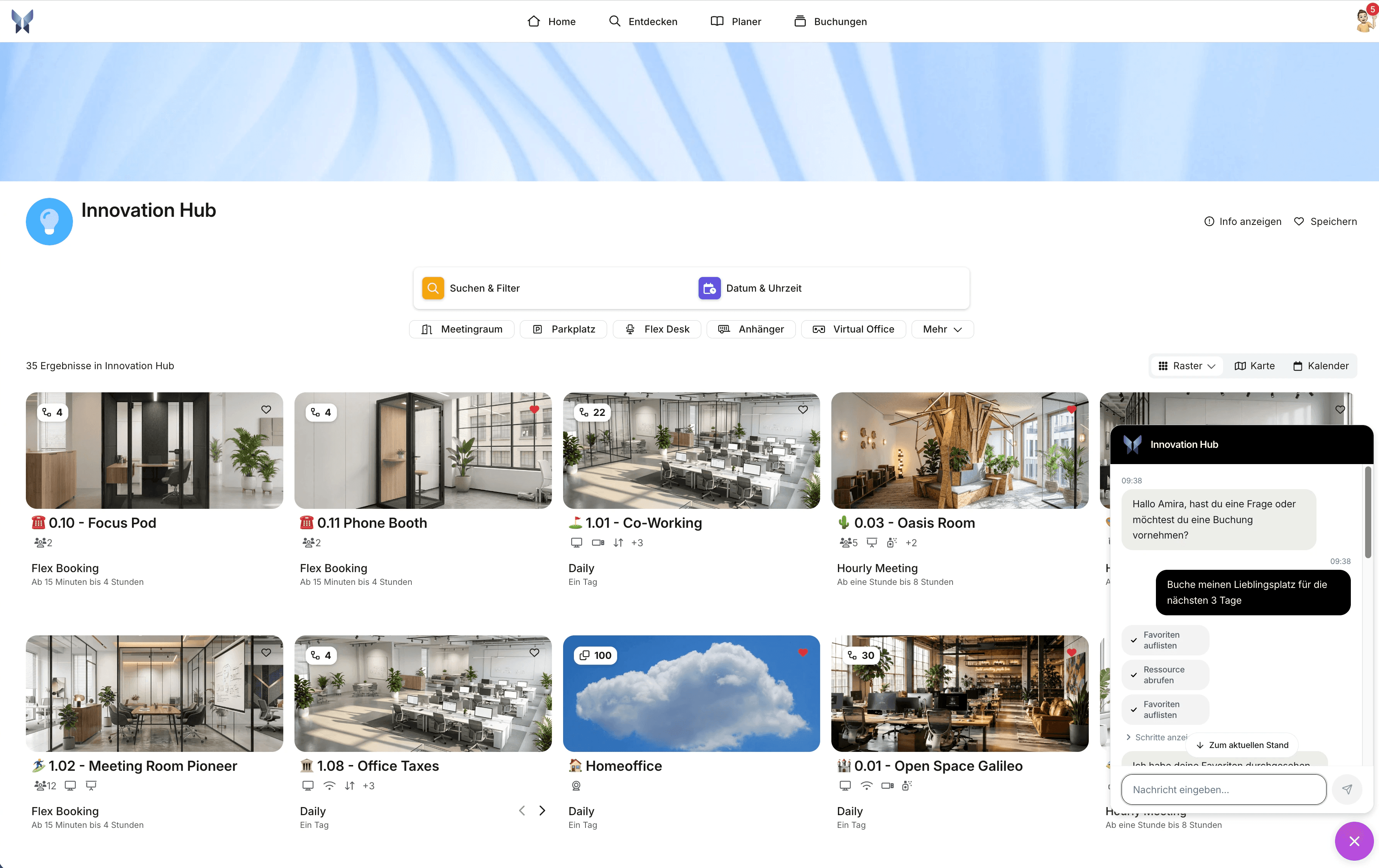
But it gets truly exciting with the next sentence. Because real planning is rarely done in just one request:
You: "Thursday 3 PM, room for 6 people with a projector."
anny: The large meeting room is fully booked. The Studio (8 seats, projector) is available, or the same room from 4 PM.
You: "Let's do 4 PM. And book my desk right next to it."
anny: Done! Desk 24 in the same area, room booked, and both are in your calendar.
Three things happen here that traditional desk sharing software simply cannot do. The assistant maintains context over multiple messages, suggests alternatives instead of just saying "unavailable", and understands spatial relationships like "next to it". A search mask turns into a conversation that actually gets results.
And that is exactly the test I would put every AI-powered desk sharing software to: What happens when the first request cannot be fulfilled? An assistant that simply points you back to the office floor plan hasn't saved you any time. It has only postponed the work.
Tangible Benefits of AI in Desk Sharing
Simple, Natural Booking
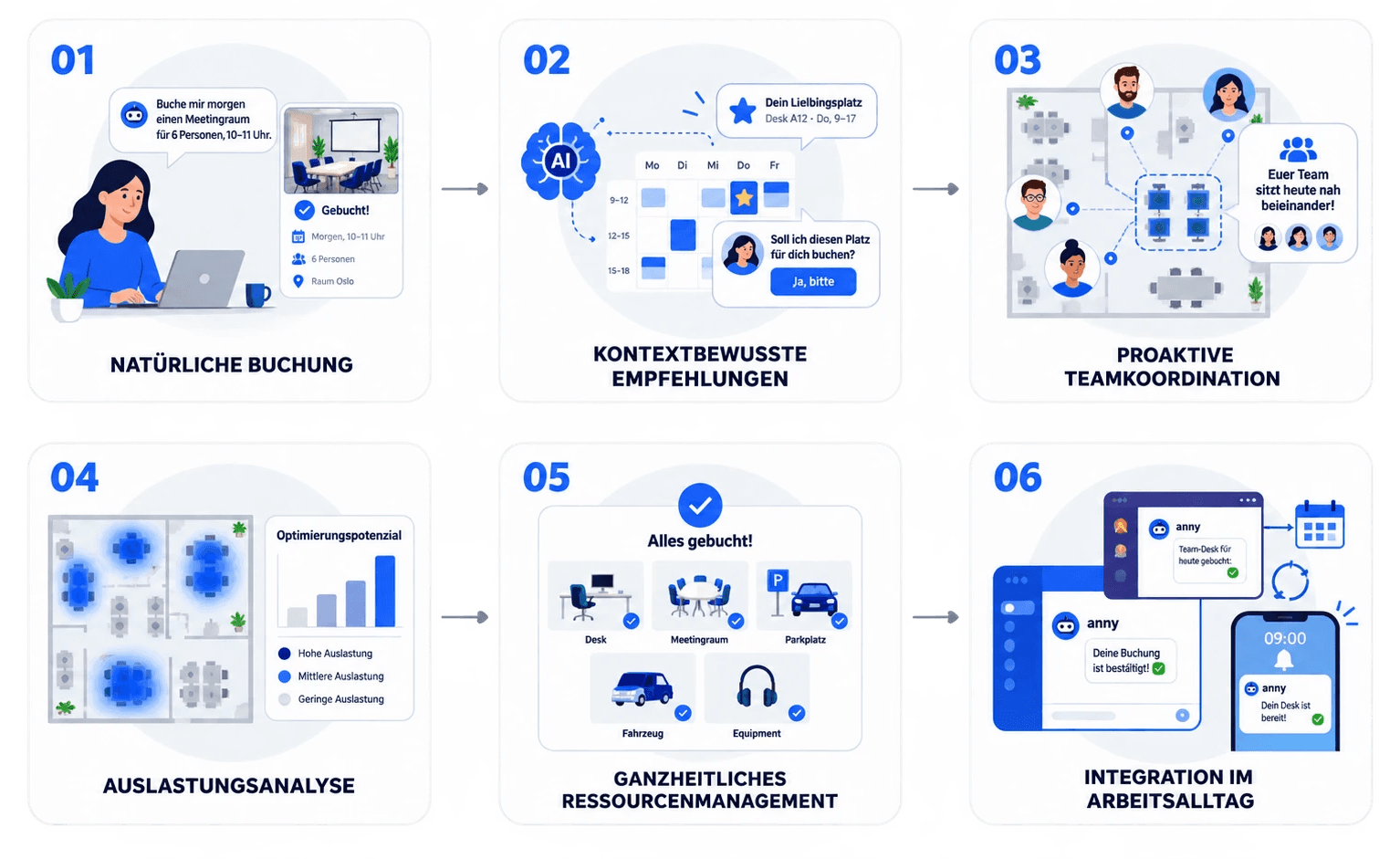
With anny, a simple sentence like "I need a meeting room for 6 people with a projector on Thursday at 3 PM" or "Book my favorite spot in the office for next week" is all it takes. The AI handles the rest – from checking availability to final booking and confirmation. This significantly reduces clicks and effort!
Context-Aware Recommendations
anny learns when employees are typically in the office, which desks they prefer, and when teams gather. This creates intelligent suggestions that make office utilization more attractive and sustainable. Instead of just showing what's free, it recommends what fits best!
Proactive Team Coordination
The AI recognizes when multiple team members are on-site on the same day, suggesting that other colleagues be included and adjacent workspaces booked. This boosts social exchange and collaboration in your hybrid work model.
Precise Utilization Analysis & Space Optimization
By analyzing check-in data and usage patterns, anny identifies areas with underutilized desks or bottlenecks. This allows companies to adapt their office space to actual demand and cut costs effectively.
Holistic Resource Management
Not just desks – meeting rooms, parking spaces, vehicles, and equipment are also fully integrated into the platform. This means employees can plan their entire workday with a single booking – a massive advantage over isolated desk booking systems!
Seamless Integration into the Daily Workflow
The anny assistant integrates beautifully into Microsoft Teams, Outlook, Google Calendar, mobile apps, and web browsers. As a result, it’s always right where your employees work, which significantly boosts adoption. Helpful reminders via email or Teams messages provide great extra support!
Limits and Challenges of AI in Desk Sharing
Because I started out as a skeptic, here is the honest flip side. Even the best desk sharing software powered by AI won't solve these four things:
Acceptance: If employees perceive desk sharing purely as a cost-cutting measure, no assistant will help. This is change management, not a tooling issue.
Lack of space: AI makes bottlenecks visible; it doesn't eliminate them. If your desk-to-employee ratio is calculated too tightly, the shortage is simply better documented through better data.
Data quality: Without a reliable check-in or sensor system, even an AI model won't know if a booked desk was actually used. Any occupancy analysis is only as good as its raw data.
Too much automation: Automatically assigning desks instead of making suggestions strips employees of control. That ruins the team's mood faster than any missing feature.
My touchstone for any AI feature is therefore simple: Does it take work away or does it create more? Everything else is just marketing.
Data Protection and Co-Determination: The Checklist for AI-Powered Desk Sharing
As soon as a system knows who is sitting where and when, personal data is generated, along with corresponding obligations. That is why anny is fully GDPR-compliant: hosting on servers in Germany, clear deletion periods, and a role concept that regulates access to attendance data. Reports run aggregated and anonymized, so that no movement profiles can be created.
When it comes to AI, there is another key question: What happens to the inputs? Whether they are used for training models and where they are processed belongs in the contract, not the sales pitch. Just as important is co-determination, because such systems are typically subject to co-determination in Germany. Involving the works council early on is much more pleasant than negotiating a completed rollout after the fact. anny AI is GDPR-compliant and hosted in the EU.
Checklist: What to look for when choosing AI-powered desk sharing software
Almost every provider is now advertising with AI. The real difference isn't found in the datasheet, but in the demo. My advice: Don't just look at a feature list—have them book your typical Wednesday. These nine questions will help you distinguish real workload relief from a superficial chatbot:
Does the assistant handle complete bookings and reduce administrative effort?
How many clicks are needed to reach the final booking, with and without AI?
Is the software seamlessly integrated with Microsoft Teams, Outlook, and Google Calendar?
Are all resources like desks, meeting rooms, parking spaces, and vehicles managed?
Are actual usage data (check-in, no-show) captured and analyzed?
Is the software GDPR-compliant, secure, and hosted in the EU?
Are there multiple access points (app, browser, displays, reception)?
How good are the onboarding processes and how reachable is the support team?
Are there meaningful references, independent reviews (e.g., OMR Reviews), and trial accounts?
The bottom line: AI needs to do more than just explain—it needs to book
My initial skepticism hasn't disappeared—it has shifted. The question isn't whether desk-sharing software has AI, but whether that AI actually takes work off your plate.
In practice, this means a single sentence is all it takes to have your workspace, meeting room, and parking spot booked in your calendar. If something is fully booked, you get a smart alternative suggestion instead of an error message. And if your team is on-site on Wednesday, you'll know before you even have to ask. This isn't just an extra feature; it's the actual work that used to be on you.
A simple assistant that only explains how to book can't do that. One with access to everything bookable absolutely can.
Put it to the test with anny: Book a demo and see what your desk sharing looks like in just 30 minutes.